
Smartphone Addiction and How Modern Phones Encourage Compulsive Use
Juan F.
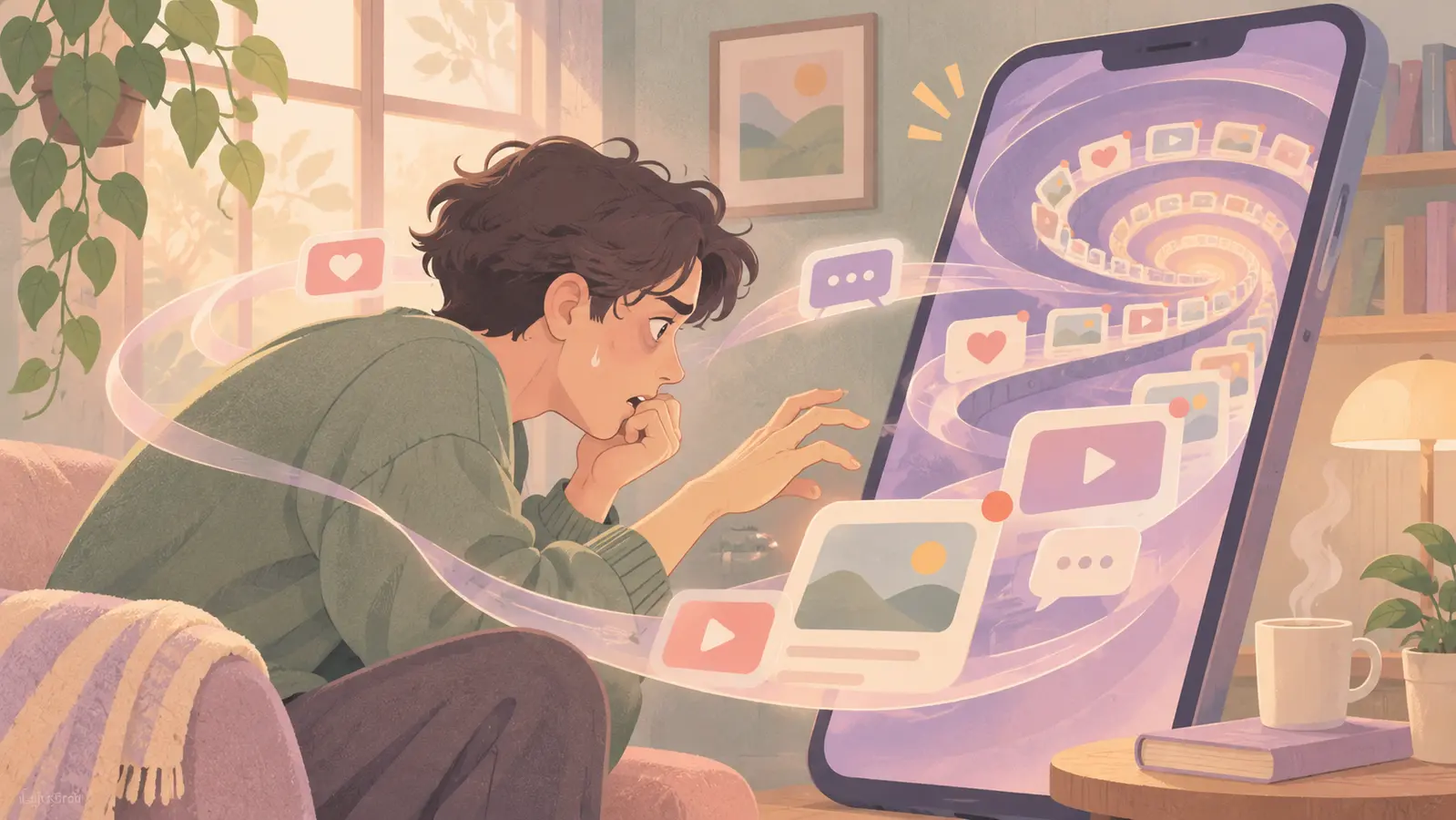
Why can smartphones be so hard to put down? Explore problematic smartphone use, the habits and design features that encourage constant checking, what research says and how to build healthier boundaries.
You pick up your phone to check the time. A notification catches your eye, so you open it, reply to a message, and notice something interesting on Instagram. A few videos later, you switch to another app. Eventually, you put your phone down and realize you never actually checked the time.
It's a small moment, but it illustrates something interesting about modern smartphones. We often pick them up with a particular intention, only to find ourselves doing something entirely different. And because our phones are almost always within reach, these little detours can happen dozens of times throughout the day.
People often call this smartphone addiction. Researchers generally prefer the term problematic smartphone use to describe patterns of phone use that feel difficult to control or interfere with everyday life. Although the scientific classification remains debated, the experience of repeatedly checking your phone, scrolling longer than intended, or struggling to disconnect is familiar to many people.
Understanding why modern smartphones encourage compulsive checking can help you recognize which habits are serving you and which ones might be taking more of your time and attention than you'd like.
What Is Smartphone Addiction?
Smartphone addiction is a commonly used term for phone use that feels difficult to control and continues despite unwanted consequences. Someone might repeatedly check their phone without a particular reason, struggle to reduce their screen time, or find themselves scrolling during activities that deserve their attention.
In scientific research, these experiences are often described as problematic smartphone use (PSU). The term generally refers to patterns involving reduced control, persistent urges, or meaningful interference with everyday functioning.
However, there's an important distinction between using a smartphone frequently and experiencing genuine difficulties with how you use it. Someone might spend several hours on their device communicating with colleagues, navigating, learning, or completing creative projects without experiencing significant problems. Another person might have considerably less screen time but feel compelled to check their phone constantly, even when they would rather be doing something else.
This is one reason researchers increasingly emphasize the importance of context and consequences rather than relying on a universal screen-time threshold. The central question isn't simply how many hours you spend on your phone, but whether you're comfortable with how you're spending them and whether you feel able to change your habits when you want to.
Why Are Smartphones So Addictive?
A smartphone is arguably one of the most useful objects most people own. It combines a telephone, camera, calendar, map, music player, television, newspaper, and countless other tools into something small enough to carry everywhere.
That convenience is part of what makes smartphones so appealing. But it also means there's almost always a reason to pick yours up, even when you don't particularly need to.
Your Phone Is Always Within Reach
Unlike a television or desktop computer, your smartphone follows you throughout the day. It's on your desk while you work, in your pocket while you walk, beside you on the couch, and often within arm's reach when you go to bed.
This constant availability makes checking remarkably easy. You don't need to make a conscious decision to sit down and browse the internet. You can simply reach into your pocket while waiting for coffee, standing in an elevator, or taking a short break between tasks.
Over time, those small interactions can become automatic. You might notice that whenever there's a moment without something demanding your attention, your hand instinctively reaches for your phone.
It's not necessarily that you have something important to do. Sometimes the phone has simply become your default response to having nothing in particular to do.
Notifications Give You Reasons to Return
Notifications are useful when they keep us informed about something that matters. A message from a friend, an important reminder, or an update about an appointment can genuinely make life easier.
The difficulty is that many apps send notifications for things that aren't particularly urgent. Social media reactions, suggested posts, promotional messages, and news updates can all interrupt your day and encourage you to open an app you weren't planning to use.
Even a notification that takes only a few seconds to check can redirect your attention. You might open a message, notice another update, and gradually move further away from whatever you were originally doing.
Eventually, checking can become proactive rather than reactive. Instead of waiting for a notification, you begin opening apps because you've grown accustomed to the possibility that something new might be waiting.
Our article on the hidden cost of push notifications explores how these interruptions can compete for our attention throughout the day.
There's Always Something Else to Do
Traditional activities often have obvious stopping points. You finish a chapter, reach the end of a television episode, or complete a conversation.
Smartphones rarely provide the same sense of completion. You can finish reading a message and open Instagram, watch a video and switch to YouTube, or check the weather before browsing the news. Each activity presents another opportunity to continue using the device.
Many apps also offer continuous feeds or personalized recommendations that make it easy to keep exploring. You may not know exactly what the next video or post will contain, but the possibility of finding something interesting can be enough to encourage another swipe.
Researchers sometimes discuss this in relation to reinforcement and habit formation. However, it would be an oversimplification to suggest that every smartphone application works like a slot machine or that unpredictable content automatically makes people addicted.
The more practical observation is that modern smartphones make continuing incredibly convenient. When there's always another activity available, stopping often requires a more deliberate decision than starting.
Your Phone Can Become an Escape From Boredom
Think about the last time you waited in line without looking at your phone. Or sat on a train without listening to something, reading something, or scrolling through a feed.
For many people, these moments have become increasingly rare. Smartphones provide immediate entertainment whenever we're bored, stressed, lonely, or simply unsure what to do next.
There's nothing inherently wrong with using your phone to relax. Watching a funny video or chatting with a friend can be an enjoyable way to spend time. But when scrolling becomes your automatic response to every uncomfortable feeling or quiet moment, it may become harder to develop other ways of responding.
You might find yourself opening social media whenever work becomes difficult, browsing shopping apps when you're stressed, or watching videos late at night because you don't particularly feel like going to sleep.
In these situations, reducing screen time isn't just about restricting access. It can also mean learning to recognize why you're reaching for your phone in the first place.
Signs Your Smartphone Use May Be Becoming Problematic
Frequent smartphone use doesn't automatically indicate addiction. However, certain patterns may suggest that your relationship with your phone deserves attention.
One of the most recognizable signs is checking your phone without thinking. You might unlock it before you've decided what you want to do, move between several apps, and realize afterward that you never had a particular reason to pick it up. You may also regularly spend longer on your device than intended, especially when a quick check turns into an extended browsing session.
Another potential warning sign is difficulty reducing your usage despite wanting to. Perhaps you've tried setting limits, moving distracting apps, or taking breaks, but repeatedly find yourself returning to the same habits. Feeling restless when your phone isn't available can also occur, although there are legitimate practical reasons to want access to your device.
The most meaningful concerns arise when phone use begins interfering with other parts of your life. You might repeatedly stay up later than planned because you're scrolling, interrupt conversations to check notifications, or struggle to concentrate on work without opening another app.
These experiences aren't a diagnostic checklist. But if your phone habits are consistently affecting your sleep, responsibilities, relationships, or well-being, it's worth considering whether something needs to change.
For a closer look at specific warning signs, our guide to phone addiction symptoms explores how to recognize when automatic checking may be becoming a problem.
How LightScroll Can Help You Use Your Phone More Intentionally
One of the frustrating things about excessive phone use is that knowing you want to change doesn't necessarily make changing easy. You might genuinely intend to spend less time on Instagram or TikTok, only to find yourself opening the same apps whenever you have a spare moment.
That's part of why we created LightScroll. Rather than requiring you to abandon your smartphone, LightScroll helps you create personalized boundaries around distracting apps and websites on supported Apple devices.
With Controls, you can choose which apps to manage, when restrictions should apply, and how much time you're willing to spend using them. For example, you might restrict social media during working hours, set a daily allowance for entertainment apps, or make certain distractions unavailable during your evening routine.
LightScroll also offers Frictions, which introduce a pause or short activity before permitted access. That moment gives you an opportunity to recognize when you're opening an app automatically and decide whether you actually want to continue.
For stronger boundaries, LightScroll Plus includes Hardcore Mode, which makes selected Controls harder to edit or delete. You can also configure Overrides that involve waiting or requesting a six-digit code from an accountability partner, adding another layer of commitment when you want additional access.
These tools aren't treatments for addiction, and they can't resolve every underlying reason someone struggles with their phone habits. But creating more deliberate boundaries can help reduce the automatic checking that makes smartphones feel difficult to put down.
The goal isn't to make your smartphone less useful. It's to preserve the things you value about your device while making it easier to step away from the activities that consume more attention than you'd like.
Learn more about how LightScroll works.
Is Smartphone Addiction a Real Addiction?
Although smartphone addiction is a familiar phrase, its classification as a distinct behavioral addiction remains an active area of research.
Currently, smartphone addiction isn't recognized as a standalone diagnosis in the DSM-5-TR or ICD-11. Researchers have developed several approaches to studying problematic smartphone use, but there is no universally accepted diagnostic framework.
Part of the difficulty comes from the nature of the device itself. A smartphone isn't a single behavior. It's a gateway to social media, gaming, shopping, messaging, news, and many other activities. Someone may struggle with a specific online activity rather than experiencing an addiction to the phone itself.
An October 2026 critical review published in Addiction examined this question directly. Researchers Elisa Wegmann, Silke Behrendt, and Janna Cousijn argued that current evidence doesn't establish problematic smartphone use as a distinct behavioral addiction. They emphasized the need for clearer definitions, stronger evidence of clinical impairment, and better ways to distinguish device use from the activities people perform on their phones.
Importantly, questioning whether smartphone addiction is a distinct medical condition doesn't mean that problematic phone habits are imaginary. People can experience genuine difficulties controlling their usage, even when researchers haven't agreed on how those difficulties should be classified.
You don't need to label yourself addicted to recognize that certain phone habits are interfering with how you want to spend your time.
What Does Research Say About Problematic Smartphone Use?
Research into problematic smartphone use has expanded considerably, particularly around its relationship with mental health, sleep, and everyday functioning. However, many studies rely on self-reported behavior, and researchers use different definitions and screening tools.
A 2024 systematic review and meta-analysis published in Cyberpsychology, Behavior, and Social Networking examined 106 articles covering 109 studies and 97,748 participants. The researchers estimated a pooled prevalence of problematic smartphone use of 37.1% across the included studies, while also identifying substantial variation between regions and measurement methods.
That figure shouldn't be interpreted as meaning that more than a third of people have a clinically diagnosed smartphone addiction. It reflects the different thresholds and screening tools used by researchers, rather than a universally accepted medical definition.
Another meta-analysis published in the Journal of Public Health in 2023 examined 27 studies involving 120,895 participants. The researchers found moderate associations between problematic smartphone use and symptoms of anxiety (r = 0.29) and depression (r = 0.28).
These relationships are meaningful, but they don't establish that smartphone use directly causes anxiety or depression. Mental health difficulties can also influence how people use their phones, and other factors may contribute to both.
Taken together, the research suggests that problematic smartphone use is worth taking seriously, while also reinforcing the importance of avoiding overly simple conclusions. High screen time alone isn't enough to establish a problem, and the same device can support someone's well-being in one context while contributing to difficulties in another.
Smartphone Addiction vs. Social Media Addiction
Smartphone addiction and social media addiction are related terms, but they aren't interchangeable.
Smartphone addiction is the broader everyday phrase used to describe problematic use involving a mobile device. This might include repeatedly checking email, playing games, browsing news, shopping online, or scrolling through social media.
Social media addiction refers more specifically to problematic patterns of engagement with social networking platforms. Someone might spend excessive time on Instagram or TikTok using a computer without having a particularly problematic relationship with their smartphone.
The two experiences can overlap, but understanding which activities are actually consuming your attention is more useful than treating every form of screen time as equally problematic.
If social media is your primary distraction, you may benefit more from changing how you use those particular platforms than from trying to reduce every minute you spend on your phone.
How to Stop Using Your Smartphone So Much
You don't need to get rid of your smartphone to develop a healthier relationship with it. In many cases, the more realistic approach is to identify which habits feel automatic and make those specific behaviors easier to manage.
Start by reviewing your screen time. Look at which apps consume the most time, how frequently you pick up your device, and when you're most likely to get distracted. You may discover that just a few applications account for most of the time you'd like to reclaim.
Then pay attention to the moments before you pick up your phone. Are you bored, avoiding a difficult task, waiting for a message, or looking for something to distract you? Recognizing those triggers can help you separate intentional phone use from habits that happen almost automatically.
Reduce unnecessary notifications wherever possible. Promotional alerts, suggested posts, social media reactions, and other nonessential updates can repeatedly encourage you to reopen apps. Keep the notifications that genuinely matter while removing some of the external prompts competing for your attention.
You can also make distracting apps less convenient to access. Move them away from your Home Screen, remove attention-grabbing widgets, or organize your device around the tools you actually need. Our guide to turning your iPhone into a dumb phone explains how to simplify your setup without buying a different device.
Creating a few predictable phone-free periods can be particularly useful. You might begin by keeping your phone away during meals, focused work, or the first thirty minutes after waking up. If scrolling regularly pushes your bedtime later, consider charging your phone away from your bed and making your evening routine less dependent on screens.
It's also worth thinking about what you'd prefer to do instead. If checking your phone has become your response to every quiet moment, simply restricting access may leave you looking for another distraction. Reading, exercising, cooking, spending time with friends, or simply allowing yourself to be bored can create room for different habits.
Finally, start small enough that your changes are realistic. Trying to eliminate every distraction overnight may be difficult to maintain, particularly if your phone is essential for work or communication. Focus on one or two behaviors that consistently interfere with your day, build boundaries around them, and adjust based on what you notice.
For a more detailed action plan, read our guide to stopping phone addiction by building friction instead of relying on willpower.
Building a Healthier Relationship With Your Smartphone
Smartphones are remarkable tools because they make communication, entertainment, information, and everyday services available almost anywhere. But that same convenience can encourage repeated checking and make it difficult to find moments when nothing is demanding your attention.
Problematic smartphone use is a meaningful area of research, although scientists continue to debate whether it should be classified as a distinct behavioral addiction. Rather than focusing exclusively on the number of hours you spend on your device, consider whether you're making intentional choices and whether your habits support the activities and relationships that matter to you.
Reducing unnecessary notifications, recognizing automatic checking, setting realistic app limits, and creating more opportunities to spend time offline can all help.
You don't need to stop using your smartphone or give up everything enjoyable about it. You simply need to make sure it remains a tool that supports your life rather than the place your attention automatically goes whenever you have a spare moment.
The goal isn't to use your phone as little as possible. It's to use it as intentionally as possible.
Frequently Asked Questions
What is smartphone addiction?
Smartphone addiction is a commonly used term for phone use that feels difficult to control and continues despite negative consequences. Researchers generally use the more cautious term problematic smartphone use.
Is smartphone addiction a real medical condition?
Smartphone addiction isn't currently recognized as a standalone diagnosis in the DSM-5-TR or ICD-11. Researchers continue to debate how problematic smartphone use should be defined and classified.
Why are smartphones so addictive?
Smartphones combine constant availability, notifications, entertainment, social connection, and easy access to different activities. These features can encourage habitual checking and extended usage, although they don't make every user addicted.
How many hours of smartphone use is too much?
There is no universally accepted number of hours that defines problematic smartphone use. The context of your usage, your ability to control it, and whether it interferes with daily functioning are more important considerations than screen time alone.
Can smartphone addiction affect mental health?
Research has identified associations between problematic smartphone use and symptoms of anxiety and depression. However, those relationships don't establish that smartphone use directly causes mental health conditions.
Can an app blocker help with smartphone addiction?
An app blocker can help establish boundaries around selected apps and websites, introduce pauses before access, and make restrictions harder to change impulsively. Tools such as LightScroll can support healthier phone habits, although they aren't medical treatments for addiction.
Sources and Further Reading
- Does Smartphone Addiction Exist? A Critical Evaluation of the Validity of Behavioural Addiction Symptoms in Problematic Smartphone Use (2026), Addiction.
- Trends and Influencing Factors in Problematic Smartphone Use Prevalence (2012–2022): A Systematic Review and Meta-Analysis (2024), Cyberpsychology, Behavior, and Social Networking.
- The Association Between Problematic Smartphone Use and Symptoms of Anxiety and Depression (2023), Journal of Public Health.