
Distracted Driving: Why Your Phone Is More Dangerous Than You Think
Derek C.
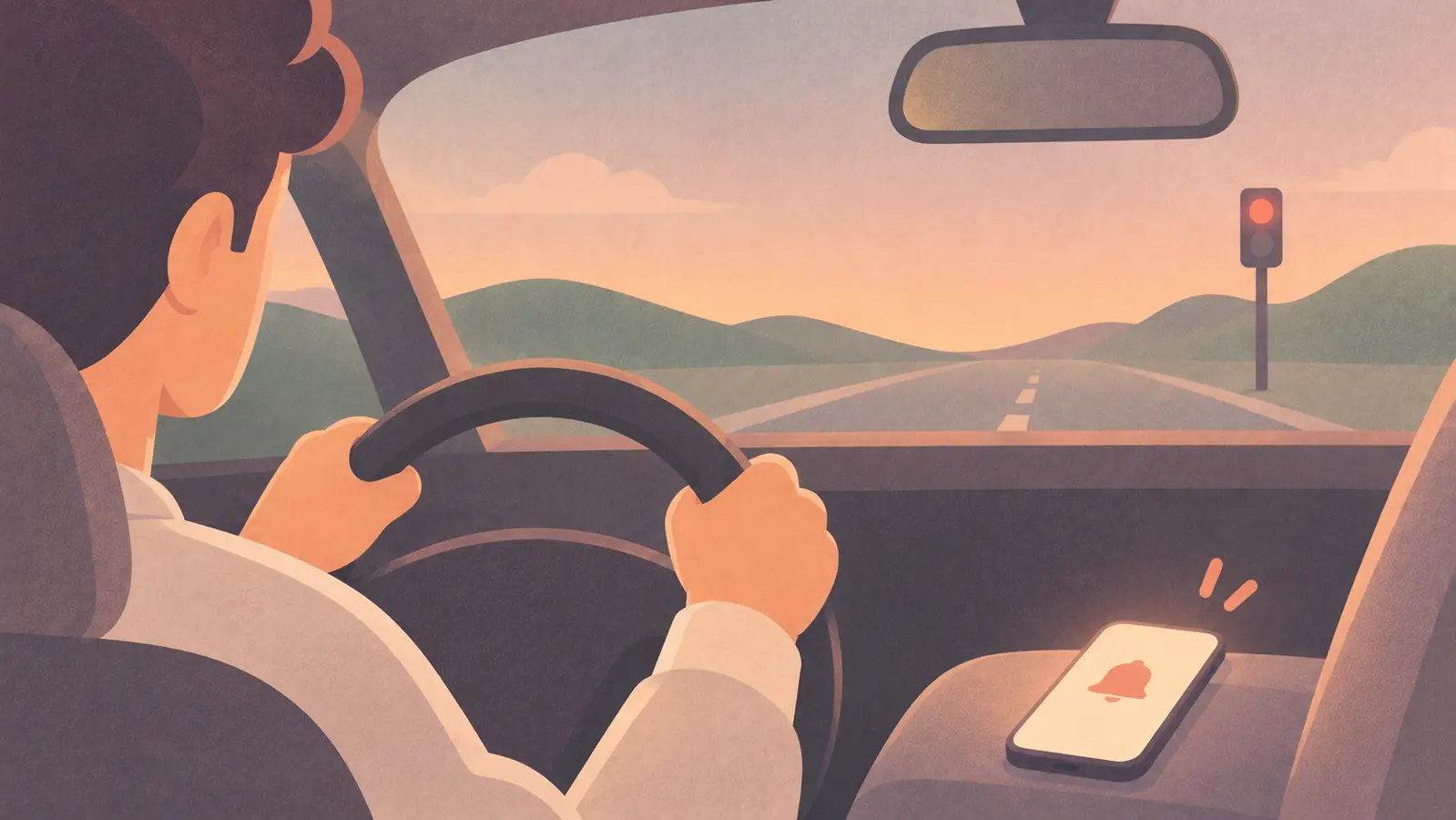
Learn what distracted driving is, why texting and phone notifications are dangerous behind the wheel, and practical ways to keep your attention on the road.
You're driving when your phone lights up with a notification. It's probably nothing important, but you glance down to see who sent it. A few seconds later, you're looking at the road again.
It doesn't feel particularly dangerous. You weren't scrolling through social media or having a long conversation. You simply checked a message.
But here's the problem: at 55 miles per hour, taking your eyes off the road for five seconds means traveling approximately 400 feet without watching where you're going.
That's more than the length of an American football field, including both end zones. And during those five seconds, another driver could brake, a pedestrian could enter the road, or traffic conditions could change unexpectedly.
This is why distracted driving is such a serious safety concern. Smartphones make it remarkably easy to redirect our attention, often through activities that seem too brief or ordinary to be dangerous.
According to the National Highway Traffic Safety Administration (NHTSA), 3,208 people were killed and an estimated 315,167 people were injured in crashes involving distracted drivers in the United States in 2024.
Understanding the risks matters because distracted driving isn't always the result of someone deliberately making a reckless decision. Sometimes it starts with an automatic habit: hearing a notification, reaching for a phone, or believing that one quick glance won't make a difference.
What Is Distracted Driving?
Distracted driving is any activity that takes your attention away from operating a vehicle safely.
The Centers for Disease Control and Prevention identifies three main categories: visual distraction, which takes your eyes off the road; manual distraction, which takes your hands off the wheel; and cognitive distraction, which takes your mind away from driving.
These categories help explain why smartphones are particularly dangerous.
Consider texting. To read or send a message, you may need to look at the screen, interact with the device, and think about what you're reading or writing. That means texting can involve all three forms of distraction simultaneously.
But distracted driving isn't limited to texting. Searching for a song, entering a destination into navigation, checking social media, reaching for something in the passenger seat, or even becoming absorbed in a complicated conversation can interfere with your ability to respond to the road.
Some distractions are more dangerous than others, and the risk depends on the circumstances. Still, the underlying problem is the same: driving requires ongoing attention, and other activities compete for the resources we need to recognize hazards and respond appropriately.
One important distinction is that keeping your eyes on the road doesn't necessarily mean your full attention is on driving.
You might be looking straight ahead while mentally occupied by a stressful conversation or something you've just read. This is cognitive distraction, and it helps explain why hands-free phone technology doesn't eliminate every risk associated with using a phone behind the wheel.
Why Is Texting While Driving So Dangerous?
One of the reasons texting is particularly risky is that people tend to underestimate how much can happen during a brief interruption.
NHTSA explains that reading or sending a text can take your eyes away from the road for around five seconds. At highway speeds, that's enough time to travel hundreds of feet.
The problem isn't simply the distance covered. It's what you might fail to notice during that time.
Imagine you're approaching an intersection when the driver ahead suddenly brakes. If you're looking at your phone, you may not recognize the situation until you've already lost valuable time to respond.
Or consider a pedestrian stepping into a crosswalk. A driver looking down at a message may miss the moment when the pedestrian becomes visible, leaving less time to stop safely.
Driving requires continuous observation, judgment, and response. It's not an activity that can be paused while you quickly check something else.
Research reinforces these concerns. NHTSA's review of distracted-driving research describes naturalistic driving studies that observed drivers in real-world conditions. These studies found that visual-manual phone activities, including texting, were associated with increased crash risk.
One analysis reported that texting was associated with approximately six times the odds of crash involvement compared with driving without secondary tasks. That estimate comes from a specific study rather than representing a fixed risk for every situation, but it illustrates how dangerous these activities can be.
The practical conclusion is straightforward: even when a message seems important, reading it while driving creates a risk that usually isn't justified by the information it contains.
What Distracted Driving Statistics Really Tell Us
The scale of distracted driving becomes clearer when you look at the national data.
NHTSA reported that 3,208 people died in crashes involving distracted drivers in 2024, representing approximately 8% of all U.S. traffic fatalities that year. An estimated 315,167 people were injured in distraction-involved crashes.
These figures include many different kinds of distraction, not just smartphones.
In the same year, NHTSA identified 437 deaths in crashes involving at least one driver engaged in cellphone-related activity.
That distinction matters because it would be misleading to attribute every distracted-driving death to phone use. Eating, adjusting vehicle controls, interacting with passengers, and other activities can also contribute.
There's another important limitation: investigators cannot always establish whether a driver was distracted immediately before a crash.
The Insurance Institute for Highway Safety notes that distraction is difficult to determine from crash reports, meaning official statistics likely underestimate its contribution to traffic collisions.
A driver may have been looking at a phone before a crash without leaving clear evidence of that behavior. Cognitive distractions can be even harder to identify because there may be no visible action to investigate.
So while the reported numbers are already serious, they shouldn't necessarily be interpreted as a complete picture of every collision involving a distracted driver.
The consequences also extend beyond the person using the phone. Passengers, pedestrians, cyclists, and occupants of other vehicles can all be harmed by a driver's momentary loss of attention.
That's what makes distracted driving different from many other unhealthy technology habits. The consequences aren't limited to the person choosing to use the device.
Why Is It So Hard to Ignore Your Phone While Driving?
Most people understand that texting while driving is dangerous. Yet knowing something is risky doesn't automatically prevent us from doing it.
One reason is that checking our phones can become habitual.
We repeatedly respond to notifications, vibrations, and moments of boredom throughout the day. Eventually, reaching for a phone can become an almost automatic reaction to certain situations.
You might not consciously decide to check Instagram every time your phone lights up. Sometimes you notice the notification and begin reaching for the device before thinking about whether the interruption matters.
This is the same broader behavior we've explored in our article, Why Is It So Hard to Stop Scrolling?, where notifications, learned routines, and the expectation of new information can encourage repeated checking.
But driving is one situation where that habit needs to be interrupted completely.
There's also a tendency to underestimate our own distraction. We might recognize that watching videos while driving is dangerous but convince ourselves that reading one short message is manageable.
The problem is that we can't reliably predict when an unexpected hazard will appear. A road that seems quiet when we look down may be very different when we look back up.
And although hands-free calling can eliminate some manual interaction, it doesn't remove cognitive distraction. A demanding or emotional conversation can still compete with the attention needed to drive.
The safest approach is not to become better at multitasking behind the wheel. It's to avoid unnecessary competing tasks altogether.
How to Prevent Distracted Driving
One of the most effective approaches to distracted driving is to make the decision not to use your phone before you start the car.
If you're already driving when a notification arrives, you're forced to decide whether to ignore it in the moment. But if you've already silenced notifications and put the device away, there's much less temptation to check.
Start by setting up anything you need before leaving. Enter your destination into navigation, choose your music or podcast, adjust your audio settings, and send any necessary messages while you're safely parked.
Then activate your phone's driving-related notification controls.
On iPhone, Apple's Driving Focus can help silence notifications while you're driving, with exceptions that you configure in advance. Android devices offer driving-related features and Do Not Disturb settings that can serve similar purposes, depending on the device.
For more information about controlling iPhone alerts, our guide to how to silence notifications on iPhone explains how Focus modes and notification settings work.
Once those settings are configured, put your phone somewhere you won't be tempted to reach for it. A bag, glove compartment, or another secure location away from the driver's immediate reach can make it easier to follow through.
I'd also recommend establishing one simple rule: don't interact with your phone while driving.
That includes reading messages at red lights, checking notifications in slow traffic, or scrolling while waiting in a queue of cars. Even when the vehicle is temporarily stopped in traffic, you still need to monitor road conditions, traffic signals, and other road users.
If something genuinely needs your attention, find a safe and legal place to pull over and park before using your device.
And if you're traveling with passengers, let them handle things like changing music or entering a new navigation destination when appropriate.
These steps aren't complicated, but that's part of their value. The goal is to remove unnecessary decisions from a situation where your attention is already needed elsewhere.
Rather than repeatedly testing your willpower, you can make driving without phone interaction your normal routine.
Where LightScroll Fits In
Distracted driving requires a particularly clear boundary: your phone should not compete with the road.
LightScroll isn't a driving-safety app, and it should never be opened, configured, or interacted with while operating a vehicle. For driving itself, use your phone's built-in Driving Focus or Do Not Disturb settings and keep the device out of reach.
However, there's a broader connection between distracted driving and everyday phone habits.
If you've become accustomed to opening social media automatically throughout the day, changing that behavior outside the car can help you establish a more intentional relationship with your phone.
That's part of why we created LightScroll.
LightScroll lets you establish scheduled Controls, daily time allowances, and Frictions around selected apps and websites on supported Apple devices. These features can help reduce unnecessary scrolling and make automatic app opening a more deliberate choice.
You can learn more about how LightScroll works, or read our guide to why adding digital friction to your phone can help.
The objective isn't to eliminate technology. It's to establish clearer boundaries around when it deserves your attention.
And when you're behind the wheel, that boundary should be absolute.
The Message Can Wait
Distracted driving is dangerous because driving doesn't allow us to predict when our full attention will suddenly become necessary.
A quick glance at a notification might feel harmless, but a few seconds can be enough to miss a braking vehicle, a changing traffic signal, or someone entering the road.
The research and national safety statistics make the consequences clear. Thousands of people die each year in crashes involving distracted drivers, and smartphones create a particularly dangerous combination of visual, manual, and cognitive distractions.
The most useful response isn't to become more confident in your ability to multitask. It's to make phone use something that happens before or after the journey, not during it.
Set your route, silence unnecessary notifications, and put the phone away before driving.
Whatever is happening on your screen can wait until you arrive. The people sharing the road with you cannot.
Sources and Further Reading
- National Highway Traffic Safety Administration. Distracted Driving: Overview and National Statistics.
- NHTSA. Distracted Driving in 2024: Traffic Safety Facts Research Note.
- Centers for Disease Control and Prevention. Distracted Driving.
- NHTSA. Understanding the Problem: Distracted Driving.
- Insurance Institute for Highway Safety. Distracted Driving.