
Social Media and Self-Esteem: Why We Compare Our Lives
Derek C.
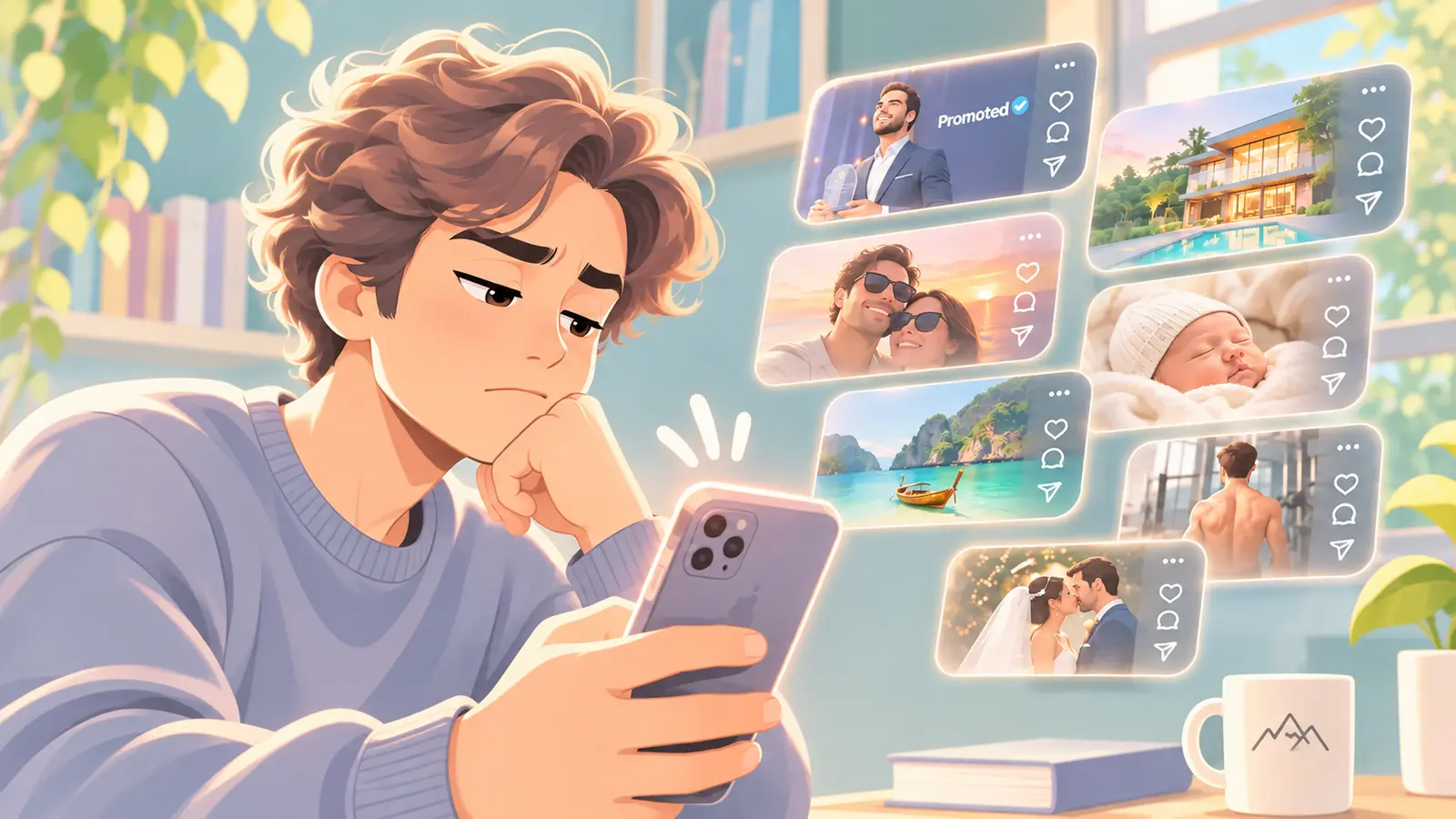
Learn why social media encourages comparison, how curated posts can affect self-esteem and practical ways to use social platforms without measuring your life against others.
You open Instagram to see what friends are doing and end up looking at someone's new home, another person's vacation, a career announcement and a stream of carefully chosen photos. Before long, you may find yourself wondering why your own life does not look as exciting, successful or put together.
This is one way social media encourages social comparison: the process of evaluating your own life, appearance, achievements or relationships against other people. Social comparison is not new, but social platforms make it easy to encounter a constant stream of other people's highlights.
Research has found associations between upward social comparison on social media and lower self-evaluations, negative emotions and aspects of psychological wellbeing. The effects are not the same for everyone, and social media does not automatically damage self-esteem. What matters includes the content you see, how you interpret it, your circumstances and how you use the platforms.
What Is Social Comparison on Social Media?
Social comparison is the process of evaluating yourself in relation to other people. You might compare your career progress, appearance, finances, relationships, fitness, travel or everyday lifestyle.
Psychologists commonly distinguish three types:
- Upward comparison: Comparing yourself with someone you perceive as doing better than you. For example, seeing a friend's promotion and feeling behind in your own career.
- Downward comparison: Comparing yourself with someone you perceive as doing worse. This can sometimes make you feel more positive about your own circumstances, though it can also encourage judgment or temporary reassurance.
- Lateral comparison: Comparing yourself with someone you perceive as similar to you, such as a friend at a similar stage of life.
Social media can expose you to all three. However, upward comparison is especially relevant when feeds are filled with idealized images of success, beauty, travel and relationships.
Why Does Social Media Make Comparison So Easy?
1. You See Other People's Highlights, Not Their Whole Lives
Most people share selected moments: a holiday, a milestone, a new purchase, a great photo or an achievement. They are less likely to post ordinary routines, disappointments, financial stress or difficult conversations.
This creates an uneven comparison. You may be evaluating your everyday life—including its uncertainty and setbacks—against someone else's carefully selected moments.
A person's feed is not a complete account of their life. It is a collection of what they chose to share.
2. There Is Always Someone to Compare Yourself With
Before social media, comparisons were often limited to people you knew personally or encountered in everyday life. Social platforms expose you to friends, acquaintances, celebrities, influencers and strangers from around the world.
You can compare your career to one person's success, your appearance to another person's photos and your lifestyle to someone else's travel posts—all in the same session.
3. Photos and Videos Can Present an Idealized Image
Lighting, angles, editing, filters, staging and selective posting all influence what appears on social media. Even authentic photos capture only a moment, not the context around it.
When you see repeated images of seemingly perfect bodies, homes, vacations or relationships, it can become easy to treat those portrayals as normal or typical.
4. Likes and Comments Make Social Feedback Visible
Many platforms display likes, comments, views and follower counts. These metrics can make social approval feel measurable.
It is easy to start comparing not only what other people share, but how much attention their posts receive. Engagement numbers do not tell you much about someone's real relationships or wellbeing.
5. Algorithms Can Repeatedly Surface Comparison-Triggering Content
Recommendation systems select content based on many signals, including interactions and viewing behavior. If you spend time watching luxury travel, fitness transformations or influencer content, you may see more of it.
This can create a feedback loop: content catches your attention, you watch it, and similar material may appear again. Over time, your feed can become an unusually narrow window into other people's lifestyles.
How Social Media Comparison Can Affect Self-Esteem
Social comparison does not affect everyone in the same way. Some comparisons can inspire people, provide useful information or create a sense of connection. Others can leave someone feeling inadequate, envious or dissatisfied.
1. You May Feel Behind in Life
Seeing other people announce promotions, marriages, home purchases, business launches or major milestones can create the impression that everyone else is progressing faster.
But people move through life at different speeds and with different resources, responsibilities and opportunities. A social feed rarely provides enough context to make a fair comparison.
2. You May Become More Critical of Your Appearance
Images of idealized bodies, beauty standards and edited photos can influence how people evaluate their own appearance.
A 2024 study examining Instagram images found that participants' body-esteem scores decreased after exposure to upward-comparison images, while downward-comparison images produced different effects. This shows that the type of comparison matters, rather than proving that all Instagram use lowers self-esteem.
3. You May Experience Envy or Dissatisfaction
Social media can make other people's experiences highly visible. Seeing someone else's holiday, relationship, home or career success may trigger envy, even when you are generally satisfied with your own life.
A systematic review of research on social comparison, envy and depression on social networking sites found associations among these experiences. The review also noted that the direction of the relationship is not simple: existing depressive symptoms may make some people more vulnerable to negative comparison experiences.
4. You May Start Measuring Your Life Through External Feedback
When likes, comments and follower counts become important measures of approval, it can be tempting to evaluate your worth through engagement.
A post receiving little attention does not mean the experience was unimportant. A highly liked photo does not mean the person who posted it is happier or more fulfilled.
What Does the Research Say?
A 2023 meta-analysis reviewed 48 articles involving 7,679 participants. It found that upward social comparison on social media was associated with less favorable self-evaluations and emotions, including outcomes related to body image, subjective wellbeing, mental health and self-esteem.
A 2025 study of young adults examined Instagram and Facebook use alongside upward comparisons and self-esteem. Across two studies, involving 139 and 413 participants, upward comparison helped explain the association between social-media use and lower self-esteem or depressive symptoms. The authors described the effects as modest and noted that individual and contextual factors matter.
A 2024 study followed 94 adolescents over 14 days, asking them to report social comparisons and how they felt about themselves. Upward comparisons at a given moment were associated with poorer self-esteem at that moment, while other types of comparison had different associations.
A 2026 meta-analysis of 54 independent samples and 36,583 participants also found that upward social comparison was associated with several indicators of psychological maladjustment, including negative social emotions, anxiety, depression and lower self-esteem and wellbeing.
Taken together, this research suggests that upward comparison is a meaningful factor to consider when thinking about social media and self-evaluation. It does not establish that social media causes low self-esteem in every user. Studies differ in their samples, methods and outcomes, and people's experiences vary.
How to Stop Comparing Yourself to Others on Social Media
You do not necessarily need to delete your accounts or stop using social media. A more practical approach is to become intentional about what you consume and how you respond to it.
1. Remember That You're Seeing a Curated Version of Reality
When a post triggers comparison, remind yourself that you are seeing a selected moment, not the full story.
You usually do not know the person's financial circumstances, personal challenges, relationships or the work behind the achievement. Avoid treating a few photos or updates as evidence that someone has a better life overall.
2. Curate Your Feed
Unfollow or mute accounts that consistently leave you feeling inadequate, envious or dissatisfied. You can also use platform tools to hide recommendations or indicate that certain content is not relevant.
Make room for accounts that teach you something, make you laugh, inspire you constructively or help you stay connected with people you care about.
3. Notice How You Feel After Using Social Media
Pay attention to your mood before and after a session. Do you feel informed, entertained and connected? Or do you regularly leave feeling behind, dissatisfied or anxious?
Simply noticing patterns can help you decide which platforms, accounts and types of content are worth keeping in your routine.
4. Stop Using Engagement as a Measure of Personal Value
Likes, views and comments are platform metrics, not a reliable measure of your worth or the quality of your life.
Try sharing things because they matter to you, rather than because you expect a particular response. You can also avoid repeatedly checking engagement after publishing a post.
5. Set Boundaries Around Passive Scrolling
There is a difference between intentionally checking in with friends and scrolling through an endless feed without a clear purpose.
Try deciding what you want to do before opening an app. For example, you might check a few friends' updates, respond to messages and then close it.
If you frequently find yourself scrolling longer than intended, read our guide to why it can be so hard to stop scrolling.
6. Invest in Experiences That Aren't Measured Online
Make time for activities that matter even when nobody sees them: learning a skill, exercising, reading, spending time with friends, enjoying nature or working toward a personal goal.
7. Compare Yourself With Your Own Progress
Instead of asking whether you are doing as well as someone else, ask whether you are moving toward goals that matter to you.
You might reflect on:
- What have I learned over the past year?
- What am I proud of that nobody sees online?
- What relationships or experiences do I want to invest in?
- What does a fulfilling life look like to me?
8. Take a Break From Accounts or Platforms That Aren't Helping
If a particular platform consistently triggers negative comparison, try stepping away from it for a few days or weeks. You can also remove the app temporarily while keeping your account.
How LightScroll Can Help You Use Social Media More Intentionally
If you find yourself opening social apps automatically or spending longer scrolling than you intended, setting boundaries around access can help.
LightScroll lets you create Controls for selected apps and websites on supported Apple devices. You can choose schedules and time allowances, and add Frictions that introduce a deliberate pause before an allowed session.
For example, you might limit access to Instagram during work, meals or the first part of your morning. You can also create periods when social apps are less accessible, making it easier to spend time on activities outside your feed.
LightScroll does not decide which accounts are healthy for you to follow or eliminate social comparison. It helps you manage access to distracting apps so you can make more intentional choices about when and how you use them.
Learn more about how LightScroll works, explore the benefits of limiting screen time, or read about why it can be so hard to stop scrolling.
The Bottom Line
Social media makes it easy to compare your everyday life with carefully selected moments from other people's lives. Upward comparisons can contribute to envy, dissatisfaction and lower self-evaluations, although the effects vary from person to person.
You do not have to abandon social media to change this pattern. Curate your feed, notice how content affects your mood, reduce passive scrolling and invest in experiences that matter outside the screen.
The most important reminder: you are comparing your full life with a small, curated part of someone else's.
Frequently Asked Questions
Why Do I Compare My Life to Others on Social Media?
Social platforms expose you to frequent updates about other people's appearance, relationships, careers, purchases and experiences. This makes it easy to evaluate your own circumstances against what you see, especially when posts present idealized or highly selective moments.
Does Social Media Lower Self-Esteem?
Research has found associations between upward social comparison on social media and lower self-esteem or less favorable self-evaluations. However, the effects vary by individual, content and context. Social media use does not automatically lower everyone's self-esteem.
What Is Upward Social Comparison?
Upward social comparison means evaluating yourself against someone you perceive as doing better than you in a particular area. On social media, this might involve comparing your appearance, career, finances or lifestyle with someone else's posts.
How Can I Stop Feeling Jealous of People on Instagram?
Notice which accounts trigger the feeling, remember that posts are curated, and mute or unfollow content that consistently makes you feel worse. It can also help to reduce passive scrolling and focus on experiences and goals that matter to you.
Is Social Comparison Always Bad?
No. Comparing yourself with others can provide inspiration, useful information and motivation. The difficulty arises when comparisons become repetitive, unrealistic or tied to your sense of personal worth.
Should I Delete Social Media if It Makes Me Feel Bad?
Not necessarily. You could first try curating your feed, limiting time on certain platforms or taking a temporary break. If your experience does not improve, stepping away for longer may be worth considering.
Sources and Further Reading
- McComb, C. A. et al. (2023). A Meta-Analysis of the Effects of Social Media Exposure to Upward Comparison Targets on Self-Evaluations and Emotions.
- Le Blanc-Brillon, J. et al. (2025). The Associations Between Social Comparison on Social Media and Young Adults' Mental Health.
- Burnell, K. et al. (2024). Adolescents' Social Comparison on Social Media: Links with Momentary Self-Evaluations.
- Taylor, J. & Armes, G. (2024). Social Comparison on Instagram, and Its Relationship with Self-Esteem and Body-Esteem.
- Lei, Y. et al. (2026). Looking Up Linked to Feeling Down: A Meta-Analysis of Online Upward Social Comparison and Psychological Maladjustment.
- Carraturo, F. et al. (2023). Envy, Social Comparison, and Depression on Social Networking Sites: A Systematic Review.