
Information Anxiety and the Stress of Knowing Too Much
Derek C.
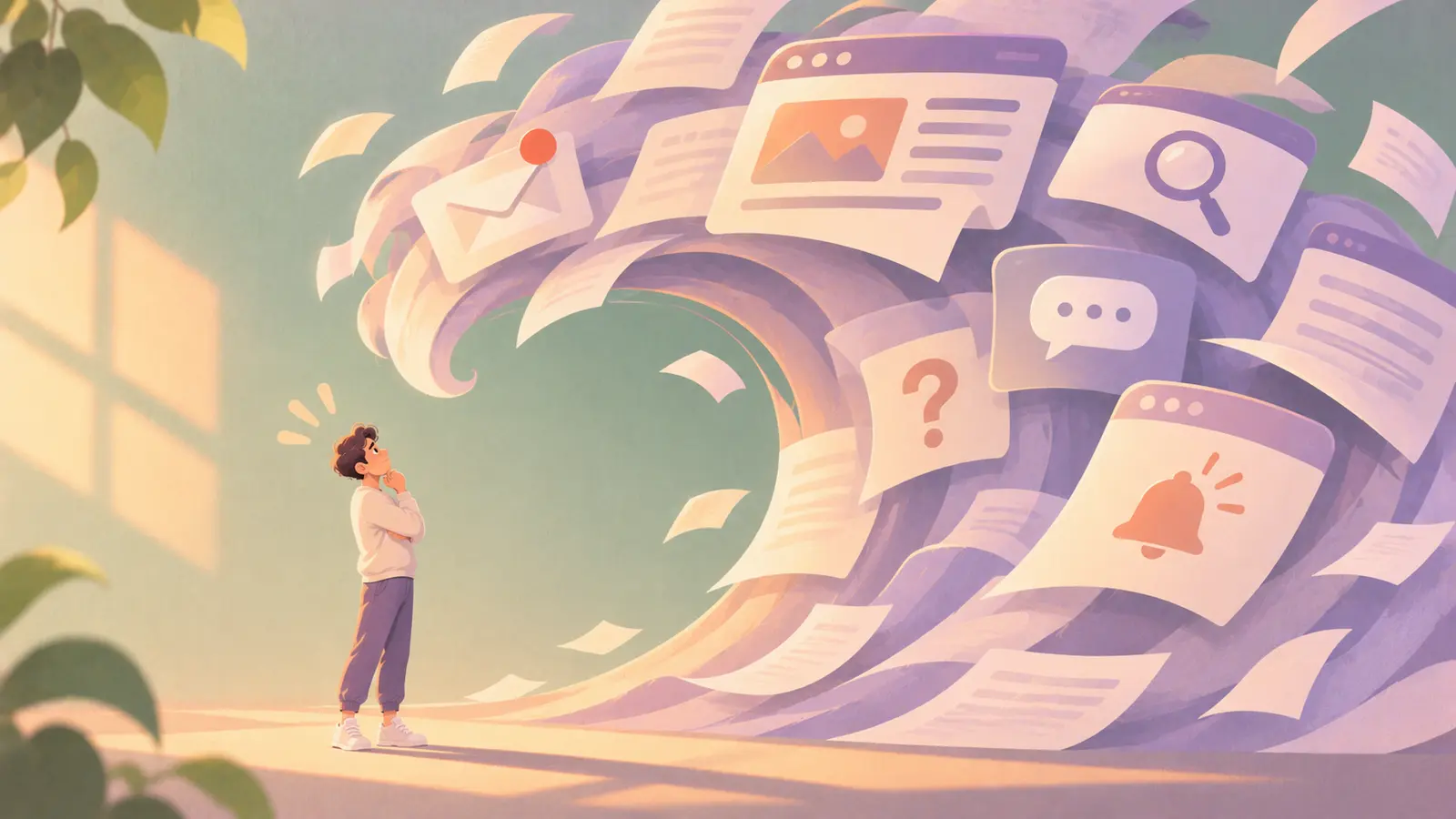
Constant updates, messages and endless information can leave you feeling overwhelmed. Learn what information anxiety is, why it happens and how to manage your digital information diet.
You check the news while making breakfast. A few minutes later, you open social media, skim a group chat, and read another headline someone shared. One story leads to another, and before you've finished your coffee, you've encountered dozens of updates about things happening around the world.
Yet somehow, you don't feel particularly informed. You feel behind.
There's always another article to read, another opinion to consider, or another development you might have missed. The more information you consume, the more aware you become of everything you still don't know.
That uneasy feeling is often called information anxiety. It describes the stress or uncertainty that can arise when information feels excessive, confusing, difficult to evaluate, or impossible to keep up with.
In a world of continuous news, social media feeds, notifications, and endless search results, the challenge isn't necessarily finding information anymore. It's deciding what deserves your attention and recognizing when you've learned enough.
What Is Information Anxiety?
Information anxiety is the worry or tension people experience when trying to find, understand, evaluate, or keep up with information. It can arise from having too much information, not having enough, encountering conflicting sources, or feeling uncertain about whether you've made an informed decision.
Imagine researching a relatively simple purchase. You begin by comparing a few options, but every review introduces another consideration. One expert recommends something different from another, online discussions disagree, and suddenly a decision that should have taken fifteen minutes has occupied your entire afternoon.
The problem isn't necessarily a lack of useful information. It's the growing feeling that you need to know more before you can confidently move forward.
Information anxiety can appear in many areas of life, from following current events and navigating workplace communication to researching health concerns or making financial decisions. It can also involve worrying that important information is being missed while you're occupied with something else.
Although the term describes a recognizable experience, information anxiety isn't a standalone medical diagnosis. It's a useful way to understand how our relationship with information can sometimes become stressful rather than helpful.
Information Anxiety vs. Information Overload
Information anxiety and information overload are closely related, but they aren't interchangeable.
Information overload occurs when the amount, pace, or complexity of incoming information exceeds what someone can comfortably process or use. Information anxiety describes the worry or uncertainty that can accompany those demands.
Think of the difference this way: information overload is opening an inbox containing hundreds of unread messages. Information anxiety is the uncomfortable feeling that something important might be buried inside and you don't know where to begin.
The two can reinforce each other. But someone can experience information overload without feeling particularly anxious, just as someone can feel anxious about not having enough information even when relatively little is available.
For a broader explanation of the cognitive demands created by excessive information, explore our guide to digital overload.
Why Does Information Anxiety Happen?
One of the strange consequences of having almost unlimited access to knowledge is that there's rarely an obvious point when you're finished learning about something.
A search leads to an article, which references a study, which introduces another question. Even after finding a useful answer, you can almost always discover more context, alternative perspectives, or recent developments. This can create the impression that you should continue researching before deciding what to do.
The fear of missing something important adds another layer of pressure. News alerts, social media notifications, and group messages can make staying informed feel like a continuous responsibility. You might check your phone repeatedly not because you're looking for something specific, but because you're uncomfortable with the possibility that something important has happened without you knowing.
Conflicting information can make the experience even more exhausting. Search results, reviews, articles, and social posts frequently present competing claims. Some sources are trustworthy, while others are incomplete or misleading. Rather than creating clarity, additional information can leave you feeling less certain about what to believe.
Social media intensifies these patterns by combining news, personal updates, opinions, entertainment, and recommendations in continuously updating feeds. You might open Instagram to see what a friend posted and end up reading about an international crisis, a controversial debate, or a subject you hadn't been thinking about five minutes earlier.
There's also the pressure to remain informed in professional life. Emails, industry news, workplace messages, and shared documents can create the feeling that you should always be monitoring something. Even after finishing work, you may find yourself checking updates because you're worried about falling behind.
Finally, information can accumulate long after you've consumed it. Saved articles, screenshots, bookmarked websites, and open browser tabs can gradually become a second inbox filled with things you feel obligated to revisit. Our guide to digital decluttering explores how to reduce that accumulated digital clutter.
The common thread is that information stops feeling like a resource you use and starts feeling like something you're responsible for keeping up with.
How LightScroll Can Help Reduce Information Anxiety
Sometimes the challenge isn't the information itself. It's how frequently distracting apps and websites invite you to consume more of it.
You might intend to check the news once in the morning but find yourself reopening it throughout the day. Or perhaps social media has become your default response whenever you're bored, uncertain, or curious about what might be happening elsewhere.
That's part of why we created LightScroll. Rather than encouraging you to disconnect completely, LightScroll helps you establish more intentional boundaries around distracting apps and websites on supported Apple devices.
With Controls, you can decide which apps to manage, when restrictions apply, and how much time you want to allow. For example, you might restrict news and social media apps during focused work, create a short evening window for catching up, or make certain feeds unavailable before bed.
LightScroll also offers Frictions, which introduce a pause or short activity before permitted access. Instead of automatically refreshing a news feed or opening social media whenever you feel curious, you have a moment to consider whether you actually need more information.
For stronger boundaries, LightScroll Plus includes Hardcore Mode, which makes selected Controls harder to edit or delete. You can also configure Overrides that involve waiting or requesting a six-digit unlock code from an accountability partner.
These tools aren't treatments for anxiety, and they can't eliminate information overload caused by demanding jobs or difficult circumstances. But they can help reduce some of the automatic checking and unnecessary digital interruptions that contribute to feeling overwhelmed.
The goal isn't to stop learning or become disconnected from the world. It's to make information something you seek intentionally rather than something that continuously demands your attention.
You can learn more about how LightScroll works.
7 Signs You May Be Experiencing Information Anxiety
Information anxiety doesn't necessarily involve dramatic symptoms. Often, it appears in ordinary habits that gradually become exhausting.
1. You constantly check for updates. You refresh the news, open social media, or check messages even when you don't expect anything new. You may feel uncomfortable going several hours without knowing what's happening.
2. You struggle to stop researching. You begin looking for an answer but continue searching long after you've found useful information. Each additional source introduces another question, leaving you less confident rather than more informed.
3. You feel overwhelmed by what you encounter. Your inbox, browser tabs, saved posts, and notifications contain more information than you could realistically process, making it difficult to decide what deserves attention.
4. You worry about missing something important. You feel pressure to monitor conversations, follow developments, or stay current with news and professional information, even when you're trying to focus on something else.
5. You have difficulty making decisions. You compare more options, read additional reviews, and search for more evidence, but struggle to move forward because you never feel sufficiently informed.
6. You feel mentally drained after browsing. You spend time reading articles, checking feeds, and moving between sources, only to finish feeling exhausted without remembering much of what you consumed.
7. You find it difficult to disconnect. You continue checking information during meals, breaks, conversations, or personal time, even when you'd rather be doing something else.
These experiences aren't a diagnostic checklist. But if anxiety is persistent, distressing, or interfering with everyday life, consider speaking with a qualified mental health professional.
What Does Research Say About Information Anxiety?
Researchers have studied information overload and its relationship with stress, decision-making, and well-being for decades, although the related concept of information anxiety isn't always defined or measured consistently.
A 2009 review by David Bawden and Lyn Robinson, published in the Journal of Information Science, examined information overload, information anxiety, and several related challenges associated with modern information environments. Their work highlighted how greater access to information can introduce new difficulties around evaluating, selecting, and managing what we encounter.
A 2012 study by Shalini Misra and Daniel Stokols, published in Environment and Behavior, examined perceived information overload from digital and physical environments. The researchers found associations between higher perceived cyber-based information overload, greater self-reported stress, poorer self-reported health, and less time devoted to contemplative activities.
These findings are meaningful, but they don't establish that information overload directly causes health problems. People's experiences and responses to information demands can vary considerably.
More recently, a 2023 systematic review published in Frontiers in Psychology examined 87 publications on preventing and managing information overload. The researchers identified strategies involving individual habits, technology design, communication practices, and organizational systems, while noting that robust evidence for the effectiveness of many specific interventions remains limited.
A 2026 systematic review published in the Journal of Documentation examined 38 peer-reviewed studies and organized information overload management strategies into four broad categories: personal approaches, organizational and technological solutions, education and training, and communication practices.
Together, these studies suggest that managing information overload requires more than simply telling people to consume less. How information is organized, delivered, prioritized, and communicated also matters.
How to Manage Information Anxiety and Stop Feeling Overwhelmed
A healthier relationship with information doesn't mean avoiding the news, abandoning research, or becoming less curious. It means being more deliberate about what you consume and recognizing when additional information is no longer helping.
One useful starting point is to choose a smaller number of reliable information sources. Rather than following dozens of accounts and publications discussing the same topic, identify a few trustworthy sources that provide the information you actually need. This is particularly important for health, legal, and financial questions, where reliable expertise matters more than the volume of opinions available.
You can also give your information consumption a clearer purpose. Before opening an app or beginning a search, consider what you're trying to learn. Are you checking a specific message, researching a decision, or catching up on an important event? Having a question in mind makes it easier to recognize when you've found a satisfactory answer.
Set intentional times to check updates rather than monitoring everything throughout the day. You might catch up on the news in the morning or evening, while reserving specific periods for nonurgent email and messages. The right schedule will depend on your responsibilities, but not every new update needs to interrupt what you're doing.
Reducing unnecessary notifications can support this approach. Turn off alerts for suggested posts, promotional messages, and routine activity that doesn't require an immediate response. Keep genuinely important communications available while removing some of the prompts that encourage repeated checking.
Another useful habit is learning when to stop researching. More information doesn't always lead to a better decision. Before comparing products, researching a topic, or evaluating options, consider what information you actually need and what would count as a satisfactory answer.
For example, a routine purchase may not require reading fifty reviews when a handful of reliable sources already provide enough information to make a reasonable choice. More consequential decisions deserve greater care, but even then, defining the questions you need answered can prevent research from becoming endless.
It's also worth reviewing your digital backlog. Saved posts, unread articles, browser tabs, and bookmarks can create a subtle sense of unfinished business. Keep what you genuinely intend to use and give yourself permission to discard material that no longer serves a purpose.
Finally, make room for periods without incoming information. Go for a walk without checking the news, enjoy a meal without scrolling, or spend time on a hobby that doesn't require constant updates. You don't need to fill every quiet moment with information simply because it's available.
Our guide to digital minimalism explores a broader approach to choosing which technologies deserve a place in your life.
The objective isn't to know less for the sake of knowing less. It's to spend more of your attention on information that's meaningful and useful, while becoming comfortable with the fact that you cannot know everything.
Learning When You Know Enough
Information anxiety reflects an interesting paradox of modern life. We have access to more knowledge than almost any previous generation, yet that abundance can sometimes make us feel less certain, less informed, and more overwhelmed.
The internet makes it possible to learn about almost anything. But it also makes it possible to spend an entire day searching, comparing, reading, and refreshing without ever feeling finished.
Creating a healthier relationship with information starts with recognizing that access doesn't create an obligation. You don't need to follow every story, read every opinion, or stay continuously updated to make thoughtful decisions and participate meaningfully in the world.
Choose reliable sources, set boundaries around distracting information streams, and give yourself permission to stop searching when you've learned enough.
Being informed doesn't mean knowing everything. Sometimes it means knowing what deserves your attention and what you can safely leave unread.
Frequently Asked Questions
What is information anxiety?
Information anxiety describes the worry, tension, or uncertainty associated with finding, understanding, evaluating, or keeping up with information. It can arise when information feels excessive, confusing, incomplete, or difficult to manage.
What is the difference between information anxiety and information overload?
Information overload describes information demands that exceed someone's ability to comfortably process or use them. Information anxiety describes the worry or tension that can develop around those demands, including concerns about missing important information.
Can too much information cause stress?
Research has found associations between perceived information overload and higher self-reported stress. However, these relationships vary by person and context, and observational studies don't establish that information exposure alone causes stress.
How can I reduce information anxiety?
Start by choosing trustworthy sources, checking updates at intentional times, reducing unnecessary notifications, and defining when you've gathered enough information to make a decision. Creating boundaries around distracting apps and websites can also help reduce automatic checking.
Sources and Further Reading
- The Dark Side of Information — Overload, Anxiety and Other Paradoxes and Pathologies (2009), Journal of Information Science.
- Psychological and Health Outcomes of Perceived Information Overload (2012), Environment and Behavior.
- Dealing With Information Overload — A Comprehensive Review (2023), Frontiers in Psychology.
- Strategies for Managing Information Overload — A Systematic Review (2026), Journal of Documentation.