
What Is Digital Overload? Signs, Causes and Solutions
Derek C.
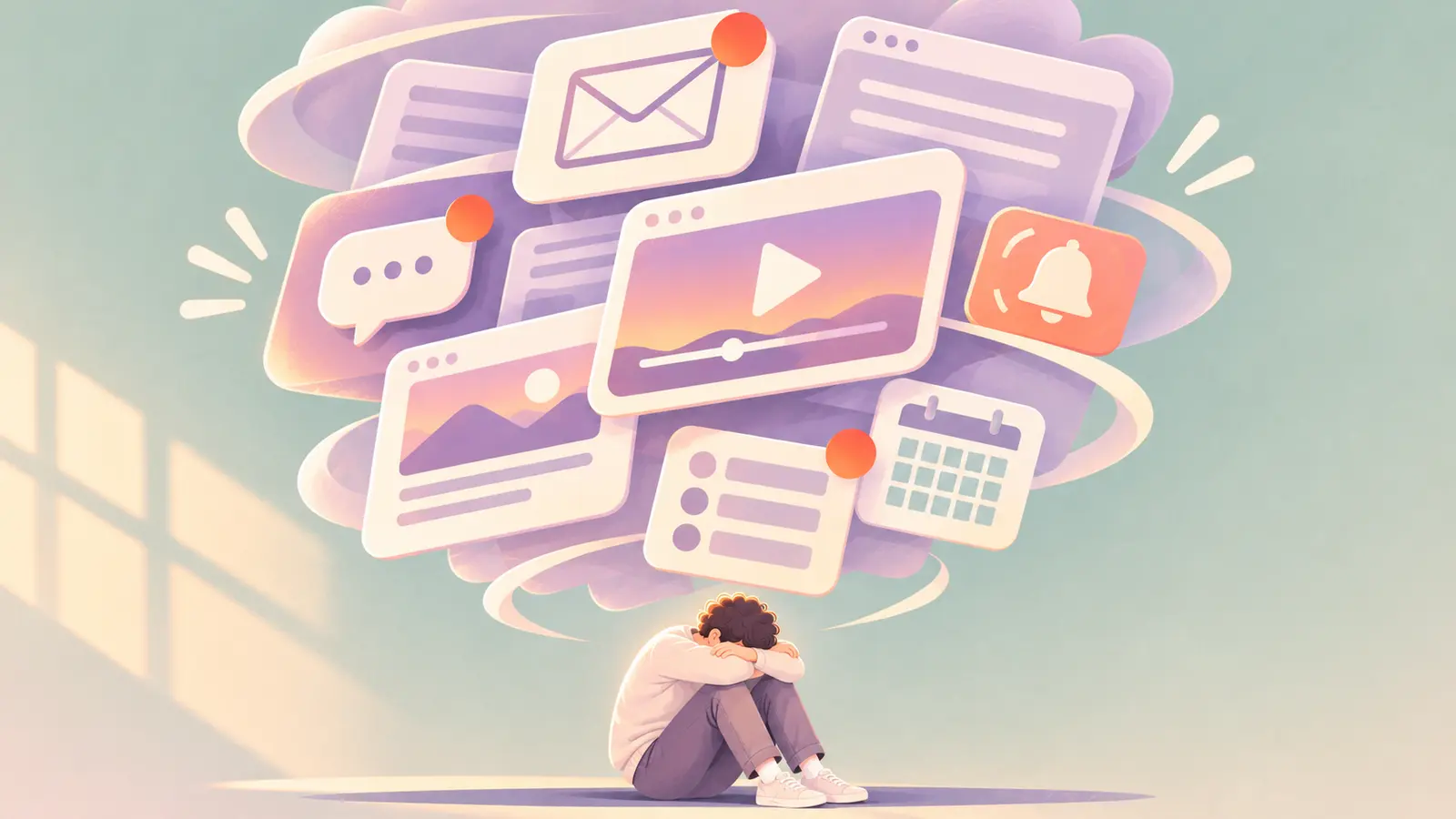
Digital overload happens when information, notifications and constant connectivity become difficult to manage. Learn the signs, causes and practical ways to reduce it.
Have you ever spent an afternoon answering messages, checking emails, reading updates, and switching between apps, only to finish feeling strangely exhausted? You might not have done anything particularly difficult, yet somehow your mind feels like it's been busy all day.
It's an interesting part of modern life. We have access to more information, entertainment, and communication than any generation before us. We can learn almost anything, talk to people across the world, and manage much of our daily lives from a device that fits in our pocket. All of that is genuinely useful, but it also means there's almost always something asking for our attention.
You might be trying to finish an important task while emails arrive, group chats keep moving, and notifications remind you about things you haven't looked at yet. Even when you're relaxing, there's another video to watch, article to read, or update to catch up on.
At some point, all that information can start to feel like a little too much. That's essentially what digital overload is: the feeling of being overwhelmed by the amount of information, communication, and activity competing for your attention through technology.
And if you've experienced it, you might find that the solution isn't necessarily spending less time on your devices. Sometimes it's about having less to keep up with in the first place.
What Is Digital Overload?
Digital overload happens when the volume or pace of digital information and demands becomes difficult to manage. It might involve a constant stream of notifications, too many communication channels, endless social media updates, or simply feeling like you need to stay connected to everything happening online.
It's closely related to information overload, a concept that researchers have studied for decades. Information overload occurs when we're presented with more information than we can comfortably process, prioritize, or use. Digital overload takes that idea into today's connected environment, where information doesn't just exist somewhere waiting for us to find it. It often arrives automatically, throughout the day, across multiple devices and apps.
Think about a typical workday. You might have email, Slack, a project management tool, several browser tabs, and your phone all competing for attention. A question arrives in one place, an update appears somewhere else, and a meeting reminder interrupts what you were doing. Individually, none of these things is especially difficult. Together, though, they can make it surprisingly hard to concentrate on one thing.
And the same thing happens outside work. There are family group chats, social media feeds, newsletters, news alerts, streaming services, and a seemingly unlimited amount of content you could spend your free time consuming.
Digital overload isn't a medical diagnosis, and it doesn't mean that using technology is inherently unhealthy. It's simply a useful way to describe what happens when our digital environment starts demanding more attention than we'd comfortably like to give it.
What Are the Signs of Digital Overload?
One of the most common signs of digital overload is difficulty concentrating. You might sit down to read something or finish a task, only to find yourself moving between apps, checking messages, and struggling to stay focused. It's not necessarily that the task itself is particularly difficult. Sometimes there are simply too many other things competing for your attention.
You might also notice that you feel mentally tired after spending time online. An hour of responding to work messages, reading headlines, and switching between conversations can feel very different from an hour spent watching a movie you enjoy or talking with a friend. The amount of screen time might be identical, but the experience isn't. When you're constantly processing new information and deciding what deserves a response, even relatively ordinary digital activities can become tiring.
Another sign is feeling like you're always behind. Maybe your inbox is full, you've saved dozens of articles you haven't read, and several group chats have conversations you haven't caught up on. None of those things necessarily requires your attention, but together they can create the impression that there's always something you're supposed to be doing. You might find yourself checking your phone repeatedly, not because you want to, but because you feel like you're missing something.
Sometimes digital overload shows up in the opposite way. Instead of checking everything, you start avoiding it. You leave messages unread, stop opening certain apps, or put off dealing with emails because the amount waiting for you feels overwhelming. That avoidance can bring temporary relief, but it may also make important responsibilities harder to manage later.
And perhaps most noticeably, digital overload can make it difficult to be fully present. You might be having dinner, watching a show, or spending time with someone while part of your attention is still occupied by whatever might be happening on your phone. Even when you're not actively using technology, you can feel like there's something waiting for you.
None of these experiences automatically means you have a serious problem, and occasional distraction or tiredness is perfectly normal. But if several of them sound familiar, it may be worth looking at whether your digital habits are adding unnecessary demands to your day.
Why Does Digital Overload Happen?
I think one of the biggest contributors to digital overload is that we've gradually accumulated more sources of information than we ever consciously decided we needed.
Maybe you subscribed to a few newsletters, joined several group chats, downloaded some news apps, and started following hundreds of accounts on social media. Each decision probably made sense at the time. But a few years later, you might be receiving information from dozens of places, many of which no longer offer much value.
The internet makes it incredibly easy to add new sources of information, but we don't always take the time to remove the old ones.
There's also the matter of notifications. Our devices can interrupt us throughout the day with messages, recommendations, news alerts, promotional offers, and reminders. Some are genuinely important, but plenty could wait until we decide to check them ourselves. Even when an interruption lasts only a few seconds, it can require us to shift our attention away from what we were doing and decide whether something else deserves a response.
Social media adds another layer because the information never really ends. You can finish reading a newspaper or watching a movie, but an endless feed will always have something new waiting. Personalized recommendations make it easier to discover interesting content, which can be a wonderful thing, but they can also make it difficult to feel finished.
At work, the problem can be particularly noticeable. Modern communication tools have made collaboration much easier, especially for remote teams, but they can also create an expectation that everyone should be reachable throughout the day. Between email, workplace chat, meetings, project updates, and shared documents, simply keeping up with communication can start to feel like a job of its own.
Researchers sometimes describe the stress associated with managing technology as technostress. A 2026 systematic review published in Computers in Human Behavior Reports examined 201 studies and found that technology-related demands such as increased workloads and the intrusion of work into personal life were frequently associated with poorer wellbeing.
That doesn't mean technology is always the cause of stress. In many cases, it's the expectations and responsibilities surrounding it that create the pressure.
And that's an important distinction, because it means the solution isn't always as simple as putting your phone away.
What Does Research Say About Digital Overload?
Researchers have studied information overload for years, and much of the evidence suggests that the problem is more complicated than simply having too much screen time.
A 2024 review published in the International Journal of Information Management Data Insights examined the causes and consequences of information overload across different environments. The researchers identified several contributing factors, including the volume and quality of information, the complexity of tasks, organizational practices, and the design of technology itself. They also found evidence linking information overload with cognitive pressure, poorer decision-making, and reduced productivity.
One thing I find interesting about that research is how much responsibility falls on the systems surrounding us, rather than just on our individual habits. If a workplace requires employees to monitor five different communication platforms, for example, telling people to concentrate harder isn't necessarily going to solve the problem.
A separate 2026 systematic review published in the Journal of Documentation examined 146 studies on information overload in digital environments. The researchers found that overload involves not just the amount of information available, but also emotional responses, individual circumstances, and the way digital platforms organize and deliver that information.
Social media has its own particular challenges. A 2025 meta-analysis published in Telematics and Informatics examined several forms of social media overload, including information overload, communication overload, social demands, and the complexity of platform features. The research linked these pressures with exhaustion and other problematic outcomes.
Taken together, these studies suggest that digital overload isn't simply a matter of spending too many hours looking at a screen. The type of information, how frequently it arrives, how much we're expected to respond, and how easily we can disconnect all play a role.
It's also worth distinguishing digital overload from related experiences. Digital fatigue describes tiredness associated with digital activity, while technostress refers to stress connected with using or managing technology. Burnout is a separate work-related phenomenon associated with chronic workplace stress that hasn't been successfully managed. These experiences can overlap, but they aren't interchangeable, and feeling overwhelmed by your inbox doesn't automatically mean you're experiencing burnout.
How to Reduce Digital Overload
If your digital life is starting to feel overwhelming, I'd begin by looking at how much information you're inviting into it.
Think about the newsletters you subscribe to, the social media accounts you follow, the news sources you check, and the apps that regularly send you updates. Are they still providing something useful, or have they simply become part of the background noise of your day?
You might be surprised how much quieter your phone feels after unsubscribing from newsletters you never read, removing unused apps, and unfollowing accounts you no longer find interesting. You don't need to give up the sources you enjoy. Just be a little more selective about which ones deserve your attention.
I'd also recommend spending a few minutes reviewing your notifications. Most phones allow you to decide which apps can interrupt you, and there's little reason to keep alerts enabled for things that aren't particularly important. Calls, messages from people you care about, calendar reminders, and security alerts may be worth keeping. Promotional messages, social media recommendations, and other engagement notifications can probably wait until you choose to open those apps.
Another change worth trying is giving yourself specific times to check information rather than monitoring it constantly. If your work allows it, you might check email at a few points throughout the day instead of keeping your inbox open the entire time. You could do something similar with social media or news, choosing when you want to catch up rather than checking whenever you have a spare minute.
Of course, not every job or personal responsibility allows for that kind of flexibility. If you need to remain available for important messages, the goal is to distinguish those from the information that doesn't require an immediate response.
It also helps to simplify the digital tools you use. If you've ended up with several apps that all serve the same purpose, consider whether you actually need them. A simpler Home Screen, fewer communication channels, and a straightforward system for organizing your files can make everyday technology easier to manage. Just be careful not to turn the cleanup into another complicated project. You don't need a perfect system; you need one that doesn't require constant maintenance.
And perhaps most importantly, remember that you don't have to keep up with everything.
You don't need to read every article you save, watch every video someone recommends, or follow every conversation happening online. There will always be more information available than you can possibly consume, and that's okay. Being informed doesn't mean knowing everything, and being connected doesn't mean being involved in every update.
Sometimes the most useful thing you can do is decide which information actually matters to you and let the rest pass by.
Make Room for Time Without Digital Demands
There's also something to be said for simply having parts of your day when you're not processing more information.
Maybe that's having breakfast without checking the news, taking a walk without listening to anything, or spending an evening reading instead of moving between apps. You don't need to avoid technology entirely, and there's certainly nothing wrong with enjoying digital entertainment. The idea is to give yourself a little time when nothing new is arriving and nothing is asking for a response.
If work is a major source of your digital overload, it may also be worth thinking about how your professional and personal time overlap. Do you regularly check work messages in the evening? Do you feel expected to respond on weekends? Are you using several communication tools that all require your attention?
Individual habits can help, but workplace expectations matter, too. It's difficult to disconnect when everyone around you assumes you'll always be available. If that's something you struggle with, our article on the right to disconnect explores why boundaries between work and personal technology have become increasingly important.
One thing I'd avoid is trying to fix digital overload by introducing a dozen new productivity apps. Sometimes another tool is useful, but sometimes the most helpful change is removing unnecessary demands rather than finding a more sophisticated way to manage them.
Where LightScroll Fits In
Of course, knowing which apps are taking more of your attention than you'd like doesn't necessarily mean you'll stop opening them automatically.
That's part of why we created LightScroll.
LightScroll helps you establish boundaries around distracting apps and websites on supported Apple devices. You can schedule restrictions, set time allowances, and introduce Frictions that encourage you to pause before opening an app.
For example, maybe you'd like to keep social media out of the way during work, spend your mornings without entertainment apps, or create quieter evenings when you're less tempted to keep checking things. Rather than making those decisions over and over again, you can put your preferences in place ahead of time.
LightScroll won't organize your inbox or reduce your workload, and it isn't a solution to every source of digital overload. But it can help with one important part of the problem: giving yourself more control over which apps can compete for your attention and when.
You can learn more about how LightScroll works, or explore our other guides on digital minimalism and healthier phone habits.
You Don't Need to Keep Up With Everything
I think one of the most useful things to remember about digital overload is that there's no realistic way to consume everything the internet has to offer. There will always be another article, another message, another video, or another conversation happening somewhere.
And while technology gives us incredible access to the world, that doesn't mean we need to make ourselves available to all of it.
If your digital life feels overwhelming, start by making it a little simpler. Reduce the number of sources you follow, turn off notifications that don't matter, and give yourself permission to step away from things that aren't adding much value.
You don't have to abandon your phone, stop using social media, or disappear from the internet. You can still enjoy the parts of technology that make life easier while being more selective about everything else.
The goal isn't to process more information. It's to have more room for the information, activities, and people that actually matter to you.
And sometimes, that starts with deciding what you don't need to keep up with.
Frequently Asked Questions
Is digital overload the same as information overload?
They're closely related, but not exactly the same. Information overload describes having more information than you can comfortably process or use. Digital overload is a broader experience that includes information along with the notifications, communication demands, and constant connectivity created by digital devices and platforms.
Can digital overload affect your mental health?
Research has associated related experiences, including information overload and technostress, with cognitive strain, exhaustion, and poorer wellbeing. However, digital overload is not a formal medical diagnosis, and these findings don't mean that every person who feels overwhelmed by technology has a mental health condition.
What is the best way to reduce digital overload?
A good starting point is reducing unnecessary sources of information and interruptions. Unsubscribe from newsletters you don't read, turn off nonessential notifications, simplify your apps, and create some time away from digital activity. If your overload primarily comes from work, clearer communication practices and more manageable expectations may also be necessary.
Sources and Further Reading
- Causes, Consequences, and Strategies to Deal With Information Overload: A Scoping Review (2024). International Journal of Information Management Data Insights.
- Dote Pardo, J. S. (2026). Information Overload in Digital Environments: A Systematic Review of Conceptualizations, Antecedents and Behavioral Consequences. Journal of Documentation.
- Mansuroğlu, E. & Smith, A. P. (2026). Technostress and Employee Well-Being: A Systematic Review of Empirical Evidence. Computers in Human Behavior Reports.
- Tyrväinen, O. et al. (2025). Overloaded Yet Addicted? A Meta-Analysis of the Outcomes of Social Media Overload. Telematics and Informatics.