
What Is the Attention Economy? Understanding the Business of Attention
Derek C.
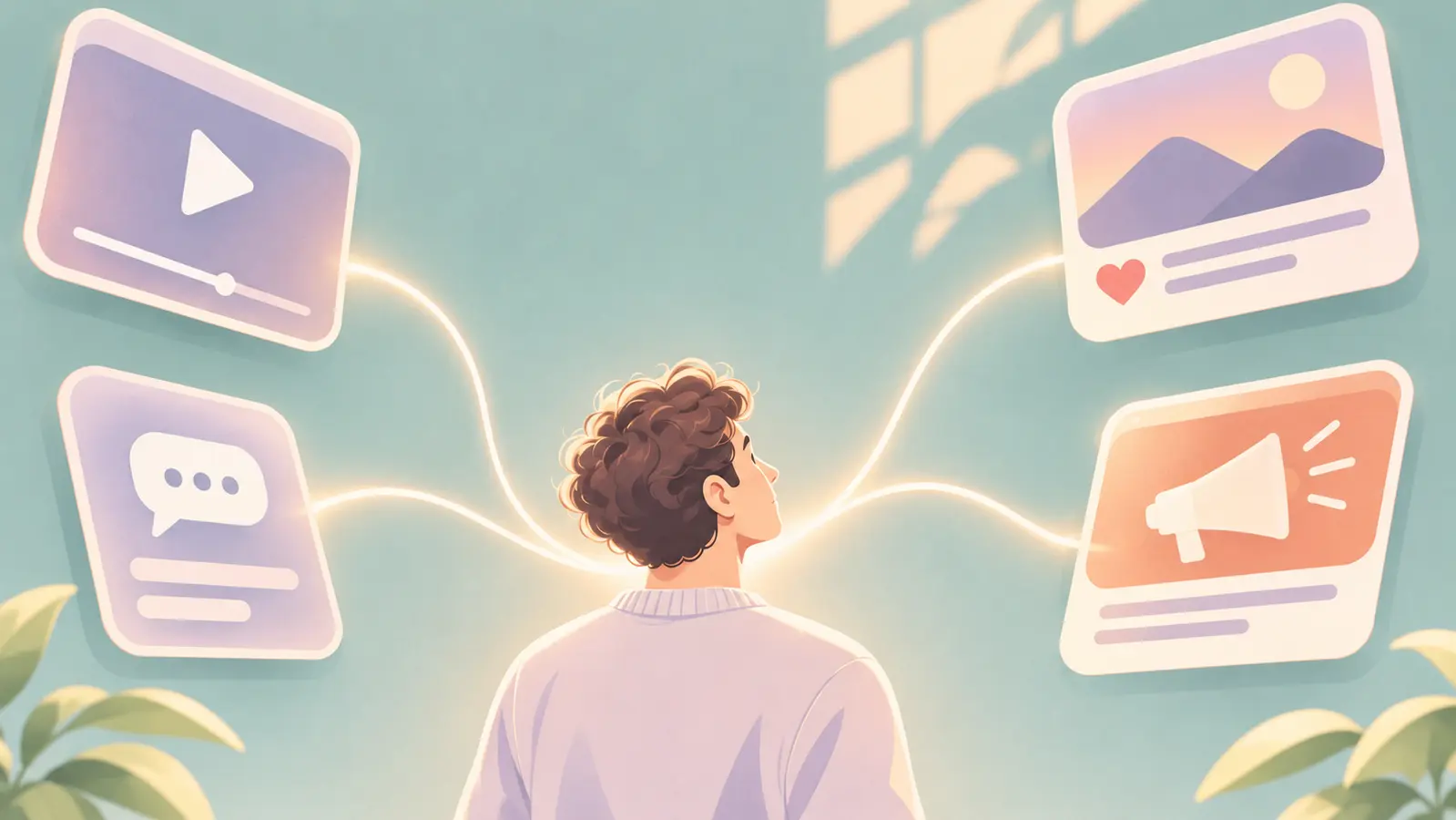
What is the attention economy? Learn how digital platforms monetize attention, how algorithms and advertising shape online experiences, and what it means for users and society.
Think about how much information you encounter on an ordinary day. Messages from friends, work emails, news headlines, social media posts, YouTube recommendations, advertisements, and notifications from apps you may have forgotten you even installed.
There's more information available to us than we could possibly consume in a lifetime, and it's all competing for a little piece of our day.
That competition has a name: the attention economy.
The attention economy describes a system in which businesses compete for people's limited time and attention, often turning that attention into revenue through advertising and other digital business models. It's one of the reasons so many online services are free to use, why recommendation algorithms have become so sophisticated, and why some apps seem to have an endless supply of things for us to watch, read, or interact with.
Understanding how it works is useful because the technology we use every day isn't designed in a vacuum. Behind every platform is a business model, and that business model can influence the experience we have as users.
What Is the Attention Economy?
The idea behind the attention economy is surprisingly simple: information is abundant, but our attention is limited.
You could spend the rest of your life watching YouTube videos and barely make a dent in what's available. The same goes for news articles, podcasts, social media posts, and almost every other form of digital content. There's always more information waiting, but each of us still has only twenty-four hours in a day.
This observation isn't particularly new. In 1971, economist and cognitive scientist Herbert A. Simon wrote an influential essay called Designing Organizations for an Information-Rich World. He argued that when information becomes abundant, the scarce resource isn't information itself, but the human attention required to process it.
It's a fascinating idea when you consider how much has changed since Simon wrote those words. Back then, there were no smartphones, social media platforms, or personalized video feeds. Yet the underlying problem was already becoming clear. As information becomes easier to produce and distribute, deciding what deserves our attention becomes increasingly difficult.
Today, the attention economy describes the commercial side of that problem. Businesses recognize that our attention is valuable, so they develop products, content, and services designed to attract it.
And importantly, this isn't limited to social media. Search engines, streaming services, online publishers, video platforms, and countless other digital businesses participate in some form of competition for our attention.
How Does the Attention Economy Make Money?
One of the easiest ways to understand the attention economy is to ask a simple question: how do companies like Google, Meta, and TikTok make money when so many of their services are free?
A large part of the answer is advertising.
Imagine you open a social media app to see what your friends are doing. You scroll through a few posts, watch a video, and perhaps spend another ten minutes exploring your feed. During that time, you encounter advertisements from businesses that want to reach people like you.
The platform provides something you find useful or entertaining, attracts an audience, and then sells advertising opportunities to companies interested in reaching that audience.
Economists describe this as a two-sided market. On one side are people using the service. On the other are advertisers who want access to those people. The platform connects the two.
This isn't entirely different from how newspapers and television networks have operated for decades. Newspapers attracted readers and sold advertising space, while television networks developed programming that brought audiences to advertisers.
What makes the modern digital attention economy different is how precisely platforms can measure and personalize the experience.
A newspaper publisher might have known how many copies were sold. A digital platform can often measure which videos people watch, how long they watch them, what they search for, which advertisements they interact with, and how frequently they return.
That information can help improve a service, but it can also make advertising more relevant and commercially valuable.
The French Treasury's 2025 report, The Attention Economy in the Digital Age, offers a detailed explanation of these business models and how consumer attention helps finance digital services.
Of course, not every app relies on advertising. Some make money through subscriptions, purchases, commissions, or a combination of revenue streams. Even so, attracting and retaining users remains important for many digital businesses, and the incentives behind a service can influence how it's designed.
Why Are Social Media Apps So Good at Keeping Our Attention?
Once you understand the business model, some of the design choices you see across digital platforms begin to make more sense.
Take personalized recommendation algorithms, for example. When you open TikTok, Instagram, or YouTube, you aren't simply seeing a random selection of content. Recommendation systems use signals from your activity to help determine what you might find interesting.
If you regularly watch cooking videos, you're likely to see more cooking content. If you spend time engaging with a particular subject, the platform may recommend similar material. Over time, these systems can become very good at identifying what you're likely to watch or interact with.
There's real value in that. Recommendation algorithms help people discover music, creators, educational material, and communities they might never have found otherwise.
But there's also an important trade-off. When a platform is optimizing for engagement, the content that keeps people watching or interacting may receive more attention than content that is simply informative or useful. The precise outcome depends on how the recommendation system is designed and which goals it prioritizes.
Other familiar design features make continuing particularly convenient. Infinite scrolling removes the natural stopping point you'd encounter at the end of a newspaper or book chapter. Autoplay starts another video before you've necessarily decided to watch it. Notifications encourage you to return to an app even when you weren't thinking about opening it.
Then there are network effects, which help explain why the largest platforms can become so influential. A social network becomes more useful when the people you want to communicate with are already using it. As more users join, the platform may attract additional creators, businesses, and advertisers, making it even more valuable to its existing audience.
The Federal Reserve Bank of St. Louis explains these dynamics in its overview of why social media platforms can offer free services.
What's interesting is that none of these features is inherently bad. Autoplay can be convenient, notifications can be genuinely helpful, and personalized recommendations can make discovering content much easier.
The question is whether the experience is helping you accomplish something you want to do or simply encouraging you to continue engaging.
Is the Attention Economy Bad for Us?
I think it's tempting to look at the attention economy and conclude that it's entirely negative. After all, many of us have experienced opening an app for one reason and spending much longer there than we intended.
But the reality is more complicated.
Advertising-supported platforms have made an enormous amount of information and entertainment accessible without requiring everyone to pay for individual subscriptions. Independent creators can find audiences, small businesses can reach potential customers, and people can connect with communities around shared interests.
Those are meaningful benefits, and they shouldn't be overlooked.
The problems arise when the incentives behind a platform don't align particularly well with what people actually want from it.
Imagine someone opens YouTube to watch a tutorial. The platform helps them find the exact information they need, which is a good outcome. But if its design then encourages them to spend another hour watching unrelated videos, the additional engagement may benefit the platform more than the person using it.
There's also an opportunity cost to our attention. Time spent doing one thing is time that can't be spent doing something else. An extra half-hour of scrolling might mean less time for sleep, exercise, reading, work, or spending time with people we care about.
That doesn't mean every minute spent online is wasted. Entertainment and relaxation are valuable, too. What matters is whether the experience is worth the time we're giving it.
The effects can also extend beyond individual habits. News organizations, political groups, businesses, and content creators compete for visibility in the same digital environment. Content that attracts strong reactions may spread quickly, even when popularity doesn't necessarily reflect accuracy or importance.
Researchers are continuing to study how engagement-based systems affect information quality, public debate, productivity, and wellbeing. These relationships are complex, and we should be cautious about claiming that all social media use is harmful or that digital platforms are responsible for every problem associated with modern technology.
Still, the broader concern is reasonable: when attention becomes economically valuable, the incentives governing what we see and how long we stay online deserve scrutiny.
The Difference Between Persuasive Design and Dark Patterns
It's also worth making a distinction between an app encouraging engagement and an app deliberately manipulating its users.
Many digital products use what's called persuasive design, meaning features intended to influence people's behavior. A language-learning app might remind you to practice, while a fitness app might encourage you to complete a workout. These features can be genuinely helpful when they're supporting goals you've chosen for yourself.
Dark patterns are different. They're interface designs that deceive, pressure, or mislead people into making choices they might not otherwise make.
For example, a website might make it easy to sign up for a subscription but unnecessarily difficult to cancel. Another might hide important information or use confusing buttons to steer people toward a particular choice.
The Federal Trade Commission's 2022 report, Bringing Dark Patterns to Light, examines these practices and explains how digital interfaces can influence consumer behavior.
Not every engaging feature is a dark pattern, and not every company participating in the attention economy is trying to manipulate its users.
But the distinction raises an important question for product designers: are we making something easier because it genuinely helps people, or because it encourages behavior that benefits the business regardless of whether users want it?
Those two goals can overlap, but they aren't always the same.
Can We Build a Healthier Attention Economy?
The attention economy isn't something we can simply turn off. Digital platforms, advertising, and recommendation systems have become deeply integrated into how we communicate, learn, work, and entertain ourselves.
But that doesn't mean the way things currently work is inevitable.
Businesses can choose to measure success through more than screen time, clicks, and engagement. A product might instead prioritize whether people accomplish their goals, find useful information, or feel satisfied with the experience. Developers can offer clearer controls, meaningful stopping points, and notification settings that give users more choice.
There's a role for public policy, too. Regulators can address deceptive design practices, data collection, competition, and risks to children while preserving the benefits of digital services.
For individuals, the changes are more immediate. Understanding the attention economy makes it easier to recognize why certain apps encourage us to return and to decide how much of our time we actually want to give them.
You might start by turning off notifications that don't really matter, using app limits, or choosing specific times to check social media. If you regularly lose track of time watching videos, creating a stopping point before opening the app can help. If your phone interrupts work or family time, keeping it out of reach for a while may be worthwhile.
None of this requires rejecting technology or treating every minute of screen time as a problem. It's simply about being a little more deliberate with a resource that's easy to give away without noticing.
For more practical ideas, you can explore our articles on the hidden cost of phone notifications and building healthier digital habits.
Where LightScroll Fits In
Understanding why digital platforms compete for our attention is one thing. Actually changing our habits can be a little harder, especially when checking certain apps has become automatic.
That's part of why we created LightScroll.
LightScroll helps people create boundaries around distracting apps and websites through scheduled Controls, time allowances, and Frictions that encourage a pause before opening something.
For example, you might want to use social media in the evening without having it interrupt your workday, or give yourself some time in the morning before opening entertainment apps. LightScroll lets you put those preferences in place ahead of time rather than making the same decision every time you pick up your phone.
It's not about avoiding technology or giving up the apps you enjoy. It's about making it easier to use them on your terms.
You can learn more about how LightScroll works.
The Attention Economy Isn't Going Away
One of the most interesting things about the attention economy is that it reveals something about the world we've built.
For much of human history, accessing information was difficult. Today, we're surrounded by more of it than we could ever hope to consume. The challenge is no longer simply finding things worth reading, watching, or learning about. It's deciding which ones deserve our time.
Digital platforms have made extraordinary things possible, and there's plenty to appreciate about that. But it's worth remembering that the services we use are shaped by economic incentives, and those incentives won't always match our own priorities.
The next time you find yourself scrolling through something longer than you intended, it might be worth thinking about the larger system behind that experience. Not to blame yourself or assume the technology is inherently bad, but simply to understand why the experience works the way it does.
Your attention is valuable, not just because businesses can earn money from it, but because it's how you choose to spend your life.
And ultimately, that choice should belong to you.
Frequently Asked Questions
Who came up with the attention economy?
The modern discussion is strongly associated with economist and cognitive scientist Herbert A. Simon, whose 1971 essay Designing Organizations for an Information-Rich World explained how an abundance of information creates scarcity in human attention. However, the commercial competition for audiences existed long before smartphones, including in newspapers, radio, and television.
How do social media companies make money from attention?
Many social media platforms earn money by selling advertising opportunities to businesses. They attract audiences through free or inexpensive services, then allow advertisers to reach those audiences. Engagement and activity signals can help platforms understand interests and improve advertising relevance. Some companies also earn revenue through subscriptions, transactions, and paid features.
What are examples of the attention economy?
Social media platforms, search engines, video services, streaming platforms, and online publishers are all examples. Familiar features include personalized recommendations, advertising-supported feeds, autoplay videos, notifications, and infinite scrolling. These features can attract or retain attention, although their purpose and impact depend on how they're implemented.
Is the attention economy the same as phone addiction?
No. The attention economy describes the economic system in which businesses compete for attention. Phone addiction is a separate term often used to describe excessive or difficult-to-control smartphone use. Participating in the attention economy doesn't mean someone has an addiction, and not every digital habit is problematic.
Sources and Further Reading
- Herbert A. Simon (1971). Designing Organizations for an Information-Rich World.
- French Treasury (2025). The Attention Economy in the Digital Age.
- Federal Reserve Bank of St. Louis (2023). Why Are Some Social Media Sites Free to Use?
- Federal Trade Commission (2022). Bringing Dark Patterns to Light.
- Daniel Chen (2026). A Model of the Attention Economy: Data, Platforms, and Discovery. American Economic Review.