
Social Media Breaks: What Happens When You Stop Checking Your Feeds?
Derek C.
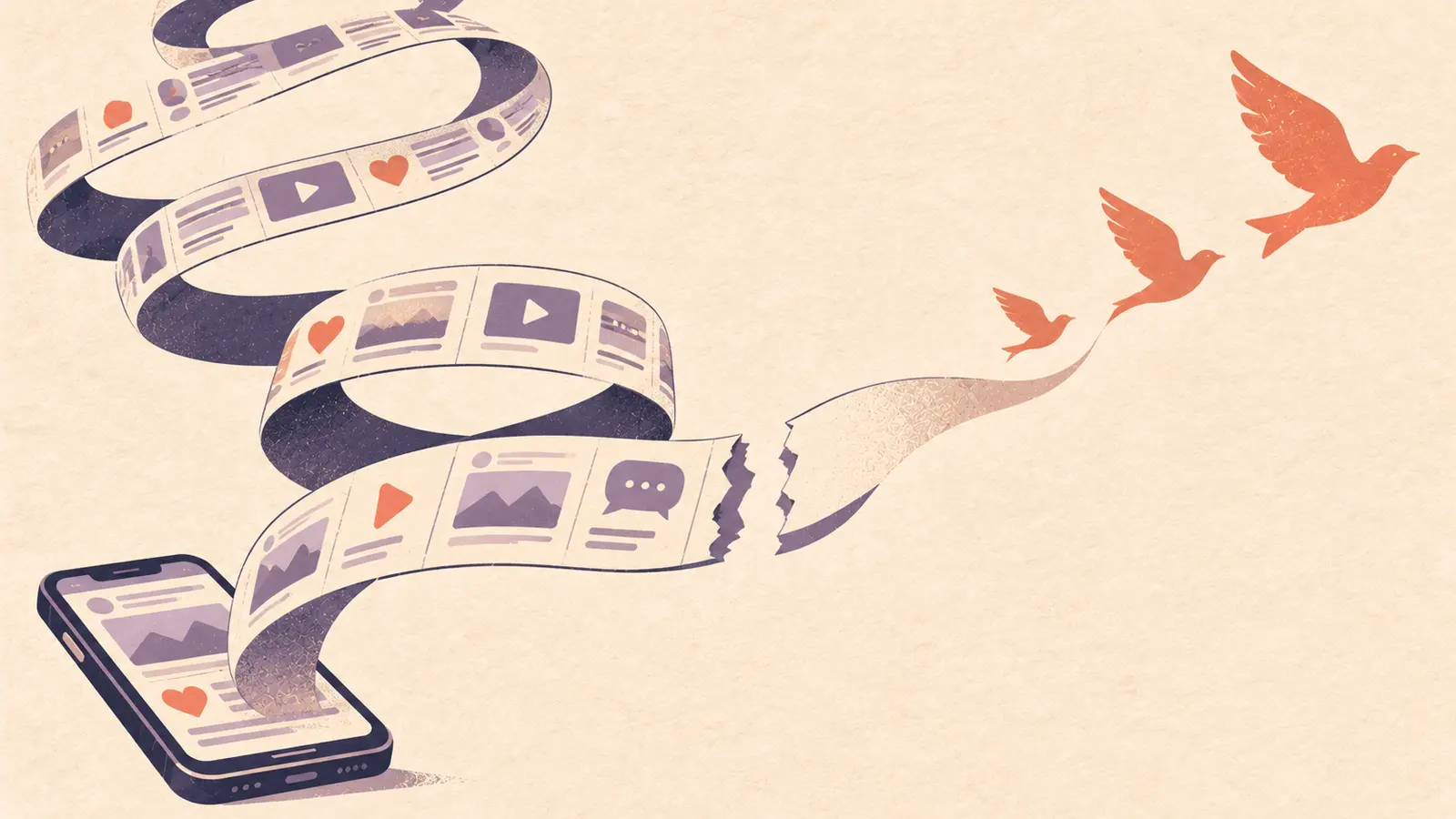
What happens when you take a break from social media? Explore the research on mood, sleep, attention and social connection, plus how to plan a realistic digital detox.
Most of us don't open social media with the intention of spending an hour scrolling. We check a message, look at a friend's post, or watch a video someone shared. Then we see something else interesting, and before long, we've spent considerably more time on the app than we planned.
There's nothing inherently wrong with enjoying social media. It helps us stay connected, discover interesting things, and entertain ourselves. But when checking our feeds becomes something we do automatically, it can be difficult to tell how much of that time we're actually choosing to spend.
That's where taking a social media break, sometimes called a social media detox, can be useful. By temporarily stepping away from certain platforms, you get an opportunity to see how they influence your habits, attention, and daily routines.
But the interesting question isn't simply whether you'll feel better without social media. It's what changes when you stop using it, and whether those changes are worth keeping.
What Actually Happens When You Stop Using Social Media?
One of the first things you may notice is how often you reach for your phone without a particular reason. Perhaps you normally check Instagram while waiting for coffee, browse Reddit between tasks, or open TikTok whenever you're bored. When those apps are unavailable, you may still find yourself reaching for them out of habit.
This happens because repeated behaviors can become associated with familiar situations. Over time, boredom, waiting, or finishing a task can become cues to open social media, even when there's nothing specific you want to see. Taking a break interrupts that routine and makes it easier to recognize how often you're checking automatically.
You may also notice boredom or curiosity about what you're missing. That's understandable when you're used to having an almost unlimited supply of entertainment and updates available at any moment. These feelings don't necessarily indicate addiction or clinical withdrawal; they may simply reflect the adjustment involved in changing a familiar habit.
Perhaps the most obvious benefit is having more time. If you normally spend an hour a day scrolling, reducing that activity frees up seven hours each week. That's time you could spend reading, exercising, working on something meaningful, or seeing friends. But there's an important catch: removing social media doesn't automatically change how you spend the time you recover.
You might simply replace Instagram with YouTube, news websites, or another distracting app. That's why a successful break involves more than temporarily deleting something. It's also about deciding whether you want to use that time differently.
There may be other changes, too. If social media regularly exposes you to posts that encourage comparison, a break can reduce that exposure. If scrolling keeps you awake later than intended, staying away from evening feeds may make your bedtime routine easier to maintain. But those benefits depend on how you use social media in the first place, and they aren't guaranteed for everyone.
Does Taking a Social Media Break Improve Mental Health?
Social media detoxes are often promoted as a way to become happier, less anxious, and more focused. There's some research supporting those possibilities, but the overall evidence is mixed.
A 2022 randomized controlled trial involving 154 adults found that participants who stopped using several major social media platforms for one week experienced improvements in measured wellbeing, depression, and anxiety compared with those who continued their usual habits.
Those findings are encouraging, but other studies have reported more limited results. A 2024 experiment examining fourteen days of social media abstinence found reductions in screen time and body-image dissatisfaction, but no significant differences between groups in several other measures, including depression, anxiety, and loneliness.
Larger research reviews provide useful context. A 2025 meta-analysis published in Scientific Reports, covering ten studies and 4,674 participants, found no statistically significant overall improvements in positive emotions, negative emotions, or life satisfaction following social media abstinence. Another 2025 meta-analysis published in SSM – Mental Health, examining 32 articles and 5,544 participants, found a small positive effect on subjective wellbeing, although results varied considerably between studies.
The important takeaway is that quitting social media isn't a universally effective mental health intervention. Some people benefit, while others notice little difference.
That makes sense when you consider how differently people use these platforms. Someone who regularly loses hours to unwanted scrolling or finds themselves comparing their life with strangers may benefit from stepping away. Someone who mainly uses social media to maintain close friendships and participate in supportive communities may experience a different outcome.
In other words, the effects probably depend less on the simple presence or absence of social media and more on what you're removing from your life when you stop using it.
Why a Complete Social Media Detox Isn't Always Better
It's tempting to think that if reducing social media is helpful, quitting completely must be even better. But that isn't necessarily the case.
Social media provides genuine benefits, particularly for people who rely on it to communicate with friends, participate in communities, or follow interests that matter to them. Taking a complete break may mean losing access to those interactions alongside the distracting content you wanted to avoid.
The distinction between actively participating and passively browsing can be helpful here. Sending a message to a friend, contributing to a community, and watching an endless stream of recommended videos are different activities with different purposes. Active participation isn't automatically beneficial, and passive browsing isn't always harmful, but separating them can help you understand which parts of social media are actually worth your time.
You might discover that you enjoy using Instagram to stay connected with friends but don't particularly value spending forty minutes scrolling through recommendations. In that case, setting boundaries around the feed may be more useful than abandoning the platform entirely.
The goal shouldn't necessarily be to eliminate social media. It should be to preserve the parts that improve your life while reducing the habits that interfere with it.
How to Take a Social Media Break That Actually Helps
If you're considering a social media break, I'd treat it as a small experiment rather than a challenge to see how long you can last without opening an app.
Start by identifying the specific behavior you want to change. Maybe you're checking your feeds too frequently, struggling to concentrate, comparing yourself with others, or spending more time scrolling than you intended. Being clear about your goal will help you determine whether the break is working.
Next, choose which platforms you want to step away from and for how long. There's no scientifically established ideal duration, but seven days is a reasonable starting point. It allows you to experience both workdays and a weekend with a different routine, without making an enormous commitment. You can temporarily delete apps, log out, turn off notifications, or use app restrictions to make the break easier to maintain.
Consider how you'll keep important communication available. If friends normally contact you through Instagram, for example, you might arrange to use text messages or preserve access to direct messaging while avoiding the main feed. There's little reason to sacrifice meaningful relationships just to avoid scrolling.
During the break, pay attention to a few concrete things. Are you checking your phone less frequently? Are you spending more uninterrupted time on activities you care about? Have your mood or sleep routines changed? And importantly, have you reclaimed any time, or simply transferred your scrolling habit to another app?
You don't need to track everything obsessively. A few observations can tell you more than simply counting the days until you're allowed to open Instagram again.
Once the experiment is finished, decide which changes you want to keep. Perhaps you'll leave certain apps off your phone, use social media only in the evening, or set daily time allowances for platforms where you tend to lose track of time.
A successful social media break isn't necessarily one that lasts the longest. It's one that teaches you something useful about your habits and helps you make a lasting improvement.
Where LightScroll Fits In
One of the challenges with changing social media habits is that knowing what you want to do doesn't always make it easy to follow through. You might decide to avoid Instagram during work, only to find yourself opening it automatically the next morning.
That's part of why we created LightScroll.
LightScroll helps you create boundaries around selected apps and websites through scheduled Controls, daily time allowances, and Frictions that encourage you to pause before opening something. You could use it to support a temporary social media break, restrict distracting feeds during work, or maintain a daily allowance after your experiment ends.
Rather than treating social media as something you must either completely embrace or abandon, LightScroll helps you establish a middle ground where you decide when and how much you want to use it.
You can learn more about how LightScroll works.
The Real Value of Taking a Social Media Break
The biggest benefit of a social media break may not be an immediate improvement in happiness, productivity, or sleep. It's the opportunity to examine habits that have become so familiar you rarely question them.
When you stop checking your feeds for a while, you may discover which interactions you genuinely miss and which ones were simply filling time. You might realize that some platforms provide meaningful connections, while others mostly encourage you to keep scrolling without much enjoyment.
And that distinction matters more than whether you manage to stay away for seven, fourteen, or thirty days.
The research doesn't suggest everyone needs to quit social media. It suggests that changing how we use it can be worthwhile, particularly when our habits no longer reflect what we want from our time.
You don't need to disappear from the internet to benefit from taking a break. Sometimes the most useful outcome is simply returning with a clearer idea of what deserves your attention.
The point isn't to prove you can live without social media. It's to make sure you're getting something worthwhile from the time you spend on it.
Sources and Further Reading
- Lambert, J. et al. (2022). Taking a One-Week Break from Social Media Improves Well-Being, Depression, and Anxiety: A Randomized Controlled Trial.
- de Hesselle, L. C., & Montag, C. (2024). Effects of a 14-Day Social Media Abstinence on Mental Health and Well-Being.
- The Effects of Social Media Abstinence on Affective Well-Being and Life Satisfaction: A Systematic Review and Meta-Analysis (2025).
- The Effects of Social Media Restriction: Meta-Analytic Evidence from Randomized Controlled Trials (2025).