
How to Create a Phone-Free Morning Routine
Derek C.
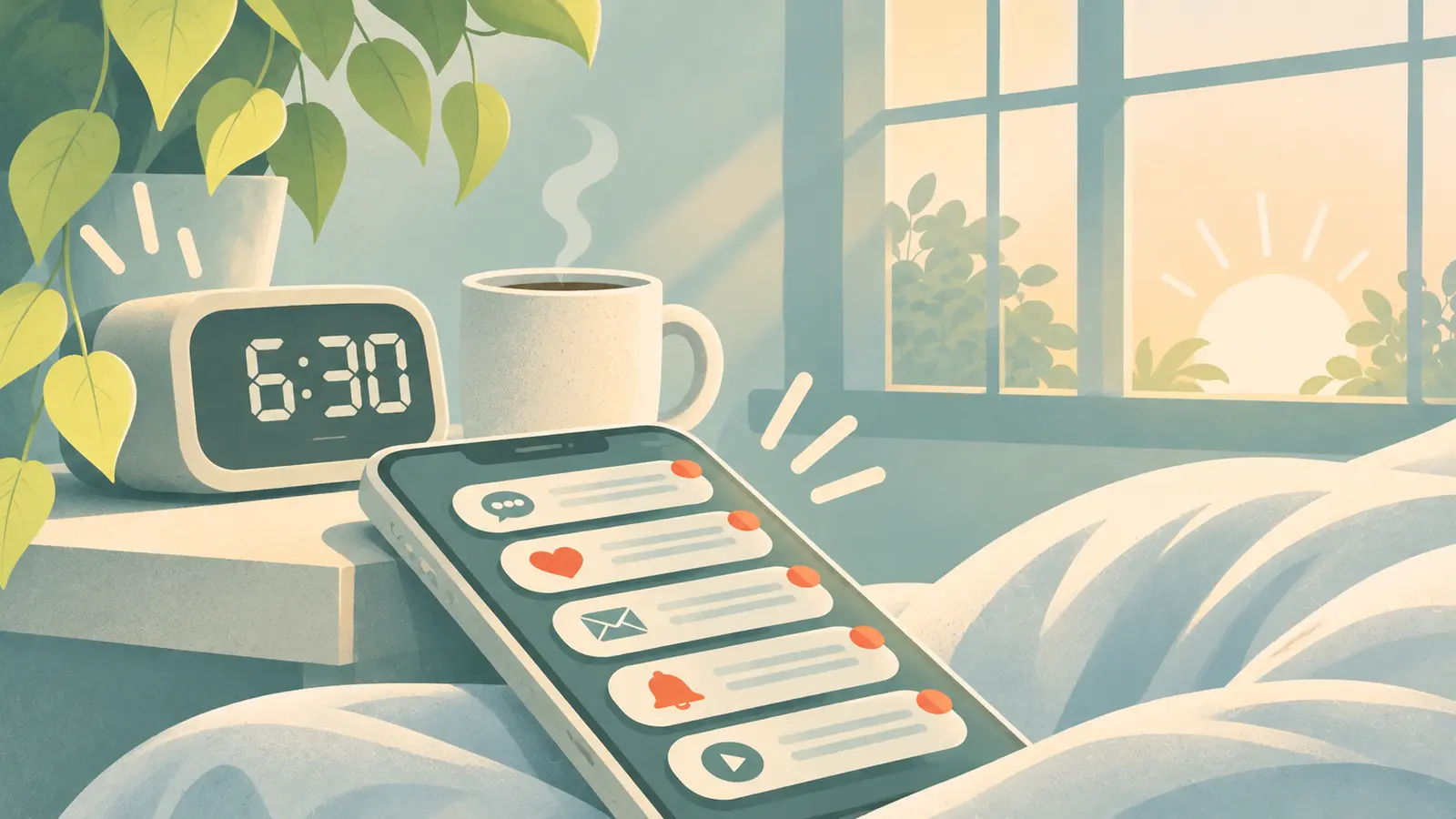
Build a healthier morning routine without reaching for your phone. Try practical phone-free habits, a simple first-hour plan and ways to make the change stick.
Think about the first thing you do when you wake up. If you're like a lot of people, you probably reach for your phone before you've even gotten out of bed. Maybe you're checking the time or seeing if someone texted you. But before long, you're reading emails, scrolling Instagram, or catching up on news you didn't particularly need to see at 7 a.m.
There's nothing wrong with checking your phone in the morning. The problem is how easily five minutes can turn into thirty, leaving you feeling like you're already behind before the day has even started.
That's why creating a phone-free morning routine can be worth trying. You don't need to become someone who wakes up at 5 a.m., meditates for an hour, and journals about gratitude. You just need a little time to yourself before the notifications and distractions begin.
And if you're wondering how long you should avoid your phone after waking up, there's no scientifically established answer. Fifteen minutes is a perfectly reasonable place to start.
Why Try a Morning Without Your Phone?
One of the nicest things about not checking your phone immediately is that you get to decide how your day begins.
When you open email first thing, you're immediately thinking about work. When you open social media, you're seeing what everyone else is doing. When you check the news, you're bringing the world's problems into your bedroom before you've even had breakfast.
None of those activities is necessarily bad, but they don't always deserve to be the first thing you do.
A phone-free morning gives you an opportunity to do something for yourself instead. Maybe that's drinking your coffee without distractions, getting outside for a walk, reading a few pages of a book, or simply taking your time getting ready.
There's also something to be said for breaking the habit of reaching for your phone automatically. In a 2022 study published in JMIR Formative Research, researchers found that 60% of a small group of 40 respondents reported usually checking their smartphones after waking up. It's a limited sample, but the behavior is probably familiar to plenty of us.
The point isn't that looking at your phone makes for a bad morning. It's that having a choice about when you look at it can make a difference to how you spend your time.
How to Start a Phone-Free Morning Routine
I'd begin by making one change: stop sleeping with your phone right next to your bed.
If your phone is within arm's reach, checking it is almost effortless. Try charging it across the room or somewhere outside your bedroom. If you use it as an alarm, you can still keep it nearby enough to hear it without having it sitting next to your pillow. A separate alarm clock is another inexpensive solution.
Next, decide how much time you'd like to spend without recreational apps after waking up. You could start with fifteen minutes, work toward thirty, or eventually try a full hour. There's no need to jump straight to an ambitious routine that makes your mornings feel like another job.
The important part is deciding what you'll do instead of scrolling. If you wake up and simply tell yourself not to use your phone, you'll probably feel tempted to check it anyway. It's much easier when you already have something else planned.
For example, a thirty-minute morning might look something like this: get out of bed, wash up, and make coffee. Spend ten or fifteen minutes walking outside or stretching, then have breakfast and think about what you want to accomplish that day. Once you're ready to begin working, check your messages and email.
That's really all it needs to be.
You can make it even easier by preparing the night before. Leave your walking shoes by the door, set out your clothes, or put a book somewhere you'll see it in the morning. Small preparations remove some of the decisions that might otherwise send you back to your phone.
And don't feel like every morning has to be identical. Some days you'll have an early meeting, family responsibilities, or somewhere you need to be. A routine that works most mornings is more valuable than a perfect routine you abandon after three days.
What If You Actually Need Your Phone in the Morning?
This is worth mentioning because avoiding your phone completely isn't realistic for everyone.
You might need it for an alarm, work, family communication, navigation, or health-related reasons. That's fine. A phone-free morning doesn't have to mean you're unreachable or unable to use useful technology.
Instead, think about separating necessary phone use from recreational scrolling.
If you need to check a work message, check it and put your phone away. If you want to play music while making breakfast, there's no reason you can't. The habit you're trying to change is opening your phone without a purpose and letting one app lead you into another.
You can also use your phone's built-in Focus settings to silence nonessential notifications while keeping important contacts available. I'd recommend turning off social-media alerts, promotional notifications, and anything else that doesn't genuinely need your attention first thing.
If you still find yourself checking certain apps automatically, consider moving them off your Home Screen. Having to search for an app won't stop you from using it, but it can make opening it a more deliberate decision.
Does Avoiding Your Phone in the Morning Actually Help?
There isn't much direct research proving that avoiding your phone for thirty or sixty minutes after waking improves your mood or productivity. It's a useful habit to experiment with, not a guaranteed health intervention.
There is, however, some research worth considering.
A 2020 study published in JMIR Mental Health surveyed 3,162 adults in Hong Kong and found that people who used electronic devices within five minutes of waking were more likely to report symptoms of anxiety and depression. The researchers also found associations between prolonged device use before bed and psychological distress.
Importantly, this was an observational study. It doesn't prove that checking your phone causes anxiety or depression. It's possible that people who are already experiencing distress are more likely to check their devices frequently.
Similarly, a 2023 systematic review published in the Journal of Clinical Sleep Medicine found an association between greater smartphone use and poorer self-reported sleep quality. That research concerns overall smartphone habits rather than morning routines specifically.
So while there's no magic number of minutes you should wait before checking your phone, giving yourself some uninterrupted time in the morning is a reasonable experiment. At the very least, it creates an opportunity to spend that time doing something else.
How LightScroll Can Help You Stick With It
If you're used to opening Instagram, YouTube, or Reddit first thing, you might find that simply deciding to stop isn't enough.
That's where LightScroll can be useful. LightScroll lets you set schedules and time allowances for distracting apps and websites, so you can create boundaries that fit your routine.
For example, you could restrict social media until 8 a.m., giving yourself time to wake up, exercise, eat breakfast, or get ready without falling into an endless feed. You can also add Frictions that encourage you to pause before opening an app, making those automatic checks a little more intentional.
You don't need to block your entire phone or give up the apps you enjoy. The idea is simply to make it easier to follow through on the boundaries you've chosen.
You can learn more about how LightScroll works or explore more ideas for building healthier digital habits on the LightScroll Blog.
Give Yourself a Little Time Before the Day Begins
If you're interested in trying a phone-free morning, my suggestion would be to keep it simple.
Tonight, put your phone somewhere other than your bedside table. Tomorrow morning, get out of bed before checking it. Have your coffee, take a short walk, read something, or just enjoy a little quiet.
Try doing that for a week and pay attention to how you feel. If fifteen minutes works, perhaps extend it to thirty. If you need your phone for something important, use it without worrying that you've ruined the routine.
The goal isn't to prove how disciplined you are or squeeze another hour of productivity into your day. It's to make room for a morning that belongs to you before everything else starts asking for your attention.
Sources and Further Reading
- Oh, K. T. et al. (2022). Using Wake-Up Tasks for Morning Behavior Change: Development and Usability Study. JMIR Formative Research.
- Lee, J. J. et al. (2020). Associations of Electronic Device Use Before and After Sleep With Psychological Distress Among Chinese Adults in Hong Kong. JMIR Mental Health.
- Chu, Y. et al. (2023). Dose-Response Analysis of Smartphone Usage and Self-Reported Sleep Quality: A Systematic Review and Meta-Analysis of Observational Studies. Journal of Clinical Sleep Medicine.