
Parasocial Relationships and Why We Feel Connected to People We've Never Met
Derek C.
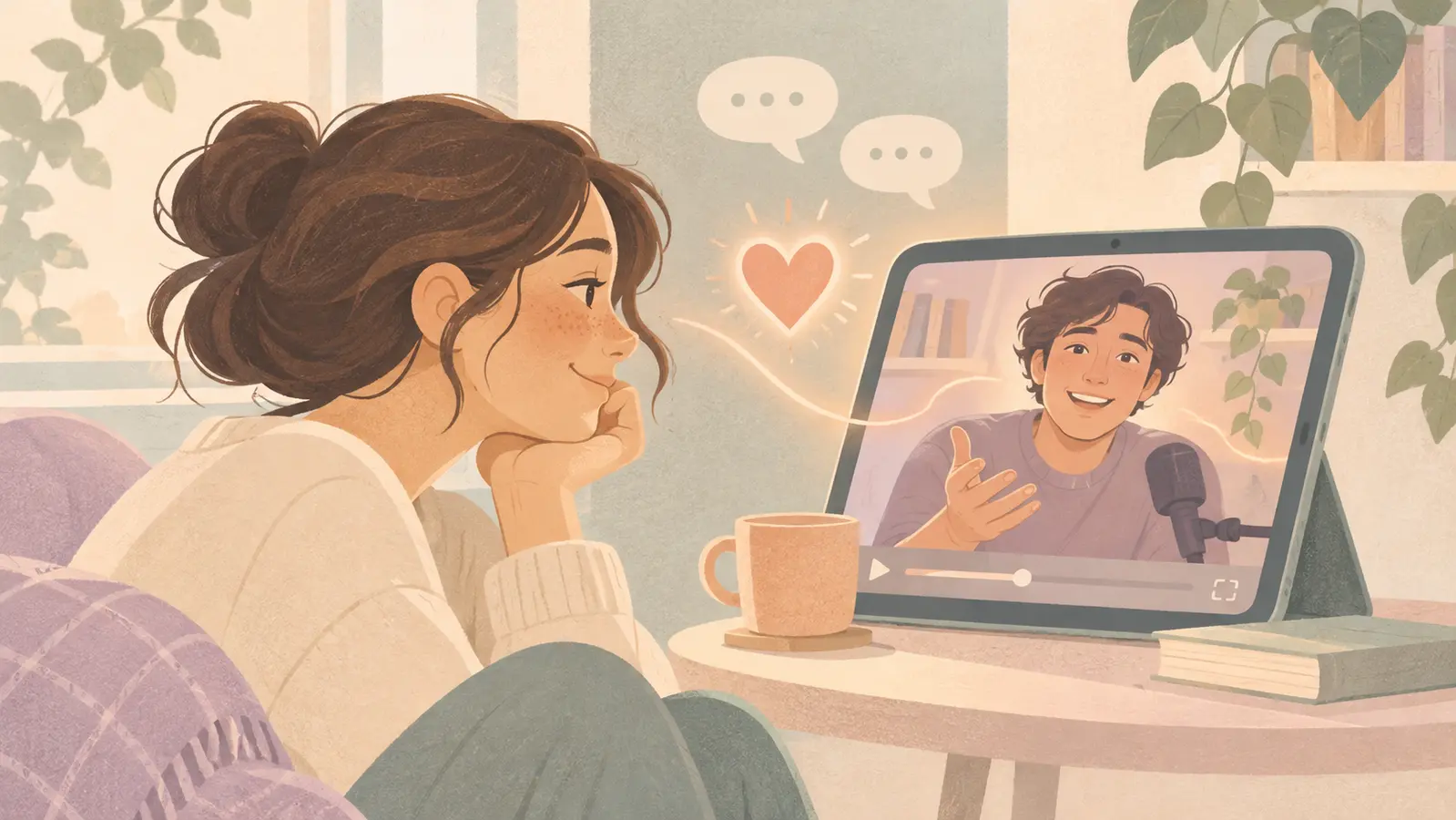
What are parasocial relationships? Learn why we feel connected to influencers, streamers and celebrities, how one-sided bonds form, and when they can become unhealthy.
Think about a YouTuber, podcaster, or social media creator you've been following for years. You've heard their stories, gotten familiar with their personality, and watched them go through different stages of their life. You probably know their sense of humor, their interests, and perhaps even the names of their friends or family members.
When something exciting happens to them, you might feel genuinely happy. When they disappear for a while, you notice. In some ways, they can start to feel like someone you know personally.
Except there's one important difference: they probably don't know you at all.
This kind of connection is called a parasocial relationship, and it's much more common than you might think. Although the term has recently become popular in conversations about influencers and social media, psychologists have been studying the phenomenon for decades.
What's interesting is that parasocial relationships aren't necessarily unhealthy or even particularly unusual. They can provide comfort, entertainment, inspiration, and a genuine sense of connection. The important distinction is understanding what these relationships can offer and where their limitations begin.
What Is a Parasocial Relationship?
A parasocial relationship is a one-sided emotional connection that someone develops with a media figure, such as an influencer, celebrity, musician, streamer, podcaster, or fictional character.
The term dates back to 1956, when sociologists Donald Horton and R. Richard Wohl published their influential paper, Mass Communication and Para-Social Interaction: Observations on Intimacy at a Distance. They observed that audiences could develop feelings of familiarity and closeness toward television personalities, even when those personalities had no personal relationship with individual viewers.
The concept existed long before smartphones. People developed attachments to radio hosts, actors, musicians, and television presenters throughout the twentieth century. Social media has simply made these connections more frequent and, in some cases, more personal.
There's also a useful distinction between parasocial interaction and parasocial relationship. Parasocial interaction describes the temporary feeling of interacting with someone while watching or listening to them. For example, when a YouTuber looks directly into the camera and tells a story, you might feel as though they're speaking to you. A parasocial relationship is the more enduring connection that develops after repeatedly following someone over time.
You don't have to believe the person actually knows you for the relationship to feel meaningful. You can fully understand that a creator is speaking to thousands of people while still feeling familiar with them or emotionally invested in their life.
That's part of what makes parasocial relationships so interesting. Our feelings of connection aren't always limited to people we know personally.
Why Do Influencers Feel Like Friends?
One of the biggest reasons parasocial relationships develop is familiarity. When you watch someone regularly, you learn their voice, expressions, opinions, humor, and habits. Over time, that repeated exposure can create a sense of knowing them, even though the information is flowing primarily in one direction.
Social media makes this especially powerful because creators often share ordinary details of their lives. You might see someone make breakfast, talk about a difficult day, celebrate a personal milestone, or discuss a relationship. Unlike a traditional celebrity who appears occasionally in films or interviews, an influencer might appear in your feed several times a day.
The result is an unusual kind of intimacy. You may know what a creator did yesterday, what they're worried about, and what they're planning next. That can create the feeling of following a friend's life rather than simply watching someone's content.
But there's an important limitation: familiarity isn't the same as mutual understanding.
You may know a great deal about a creator's public life, but they know very little about yours. You're also seeing the version of themselves they choose to share, rather than the full complexity of who they are.
Livestreams and comments add another layer. A creator might respond to your question, recognize your username, or thank you for supporting their work. Those interactions can be genuine, but they don't necessarily establish the kind of reciprocal relationship you'd have with a close friend.
This doesn't mean creators are being dishonest or that their relationships with audiences are meaningless. Many genuinely appreciate the people who follow them. It simply means that a relationship between a creator and their audience operates differently from a personal friendship.
The connection can feel close without being equally personal on both sides.
Are Parasocial Relationships Healthy or Unhealthy?
The research suggests that parasocial relationships aren't inherently good or bad. Their effects depend on the person, the nature of the connection, and how it fits into their everyday life.
A 2024 study published in Scientific Reports examined how people perceived parasocial relationships as sources of emotional support. Across three studies involving 3,085 participants, researchers found that people sometimes rated strong connections with media figures as more effective at fulfilling certain emotional needs than relationships with acquaintances they knew in person.
However, close, reciprocal relationships were consistently rated more highly.
That's an interesting finding because it challenges the assumption that one-sided relationships are necessarily superficial. A familiar creator might provide comfort during a difficult period, introduce someone to a new interest, or make them feel less alone. Those experiences can be genuinely meaningful, even without a personal connection.
At the same time, parasocial relationships have limitations. A favorite podcaster might provide companionship during a lonely commute, but they generally can't recognize when you're struggling, offer personalized support, or participate in your life in the way a close friend can.
A 2026 systematic review and meta-analysis published in JMIR Mental Health examined 17 studies on parasocial engagement with social media influencers. Researchers found associations with both positive outcomes, including wellbeing, and negative outcomes, including problematic social media use.
The overall associations were stronger for positive outcomes, but the results varied considerably depending on the type of parasocial engagement, age group, and outcomes measured. Much of the underlying evidence was observational, so these findings don't establish that parasocial relationships directly cause improvements or problems in mental health.
The broader conclusion is that parasocial connections can be meaningful without necessarily being a substitute for mutual relationships.
And that's probably the most useful way to think about them.
When Can a Parasocial Relationship Become Unhealthy?
The fact that a relationship is one-sided doesn't automatically make it a problem. You can look forward to a creator's videos, admire their work, or feel emotionally connected to their story without anything unhealthy happening.
Concerns arise when the connection begins to interfere with other parts of your life or creates expectations that the relationship can't realistically fulfill.
For example, you might start feeling obligated to watch every video or attend every livestream because you don't want to miss something. Your mood might become unusually dependent on what the creator posts, or you might feel personally rejected when they don't respond to a comment.
There's also a financial dimension worth considering. Subscriptions, donations, memberships, and merchandise can be perfectly reasonable ways to support creators whose work you enjoy. But spending becomes more concerning when someone feels they need to give money to earn personal attention, recognition, or closeness.
The distinction between appreciation and expectation matters here. It's reasonable to value someone's work and want to support them. It's different to believe that supporting them entitles you to a personal relationship.
Another concern is when following creators begins to displace relationships with people in your own life. If you're repeatedly choosing to monitor someone's online activity instead of spending time with friends, family, or other people you care about, it may be worth reconsidering how much attention the connection is receiving.
None of these behaviors automatically indicates a mental health disorder. They're simply signs that an online relationship may be taking more emotional energy, time, or money than you intended.
How to Keep Parasocial Relationships in Perspective
I don't think the solution is to stop following creators or feel embarrassed about becoming invested in someone's work. We form emotional connections through stories, music, entertainment, and shared experiences all the time. That's part of being human.
A more useful approach is to recognize the difference between enjoying someone's content and expecting a reciprocal relationship with them.
You can appreciate a creator's personality without assuming you know everything about who they are. You can feel happy about their accomplishments without needing to follow every update. And you can support their work financially without expecting personal attention in return.
It's also worth noticing how certain accounts make you feel. Perhaps a creator inspires you to learn something new or pursue a hobby. That's a meaningful benefit. But if following someone consistently leaves you feeling inadequate, overly preoccupied, or frustrated about their personal decisions, you might benefit from spending a little less time with their content.
Maintaining relationships with people who know you personally is important, too. A parasocial connection can add something valuable to your life without needing to replace friendships, family relationships, or other sources of mutual support.
And perhaps most practically, you don't need to keep up with everything someone publishes. A creator might post several times a day, but that doesn't create an obligation for you to watch it all.
Their content can be available whenever you want to enjoy it without becoming another responsibility in your schedule.
Where LightScroll Fits In
Parasocial relationships aren't something an app blocker can diagnose or resolve, and feeling connected to creators isn't inherently a problem.
But if keeping up with influencers, livestreams, or social media updates has become a habit that takes more time than you'd like, creating some boundaries around those apps can help.
That's part of why we created LightScroll. It lets you establish scheduled restrictions, daily time allowances, and Frictions that encourage you to pause before opening distracting apps or websites.
For example, you might want to enjoy your favorite creators in the evening without checking their content throughout the workday. Or perhaps you'd like to spend less time browsing social feeds while keeping access to direct messages and other useful features.
The goal isn't to stop enjoying online communities. It's to make sure following them remains something you choose to do, rather than something that constantly demands your attention.
You can learn more about how LightScroll works.
Feeling Connected Isn't the Same as Knowing Someone
Parasocial relationships reveal something interesting about how we connect with people. We don't necessarily need to meet someone personally to find their stories meaningful, feel comforted by their presence, or become invested in what happens to them.
That isn't inherently strange or unhealthy. Some of our most memorable experiences with music, films, books, and online content come from feeling connected to people we've never met.
But there's still a meaningful difference between knowing a great deal about someone and having a relationship with them.
A creator can inspire you, entertain you, or provide a sense of familiarity. A close friend can also know you, respond to your experiences, and participate in your life in ways that a public figure generally cannot.
There's room for both kinds of connection, provided we understand what each one offers.
You can genuinely care about someone you've never met without expecting them to know you in return.
And that understanding can make the relationships we form through media more enjoyable, while leaving plenty of room for the people and experiences in our own lives.
Sources and Further Reading
- Horton, D., & Wohl, R. R. (1956). Mass Communication and Para-Social Interaction: Observations on Intimacy at a Distance. Psychiatry.
- Lotun, S. et al. (2024). People Perceive Parasocial Relationships to Be Effective at Fulfilling Emotional Needs. Scientific Reports.
- Liu, J., & Lee, J.-S. (2024). Social Media Influencers and Followers' Loneliness: The Mediating Roles of Parasocial Relationship, Sense of Belonging, and Social Support. Online Media and Global Communication.
- Li, Y., Liu, Z., & Liu, F. (2026). Parasocial Engagement With Social Media Influencers and Mental Health Outcomes: Systematic Review and Meta-Analysis. JMIR Mental Health.