
The Online Disinhibition Effect and Why People Behave Differently Online
Juan F.
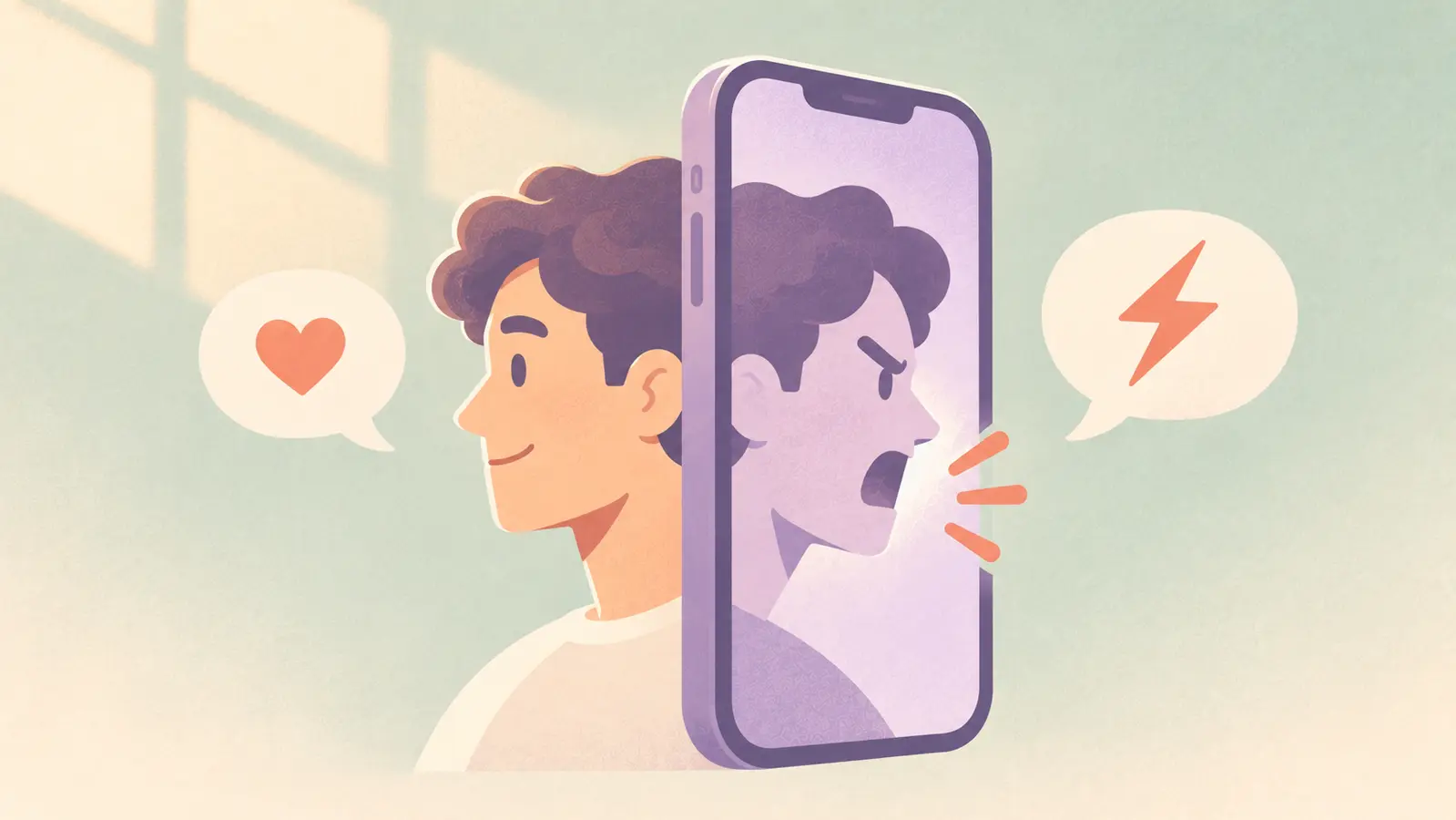
What is the online disinhibition effect? Explore why people act differently online, from anonymity and reduced social cues to oversharing, trolling and online kindness.
Have you ever read a comment online and wondered whether the person would actually say the same thing to someone standing in front of them?
Maybe it's an unnecessarily cruel reply to a stranger, an aggressive argument over something trivial, or a personal insult that seems completely disproportionate to the conversation. Sometimes the internet can make otherwise ordinary people seem remarkably hostile.
But the opposite happens, too. People share deeply personal experiences with strangers, ask for help with things they're embarrassed to discuss in person, and offer extraordinary kindness to people they've never met.
What makes someone behave so differently through a screen?
Psychologists call this the online disinhibition effect, a phenomenon that helps explain why people sometimes express themselves more freely, emotionally, or aggressively online than they would face to face.
The interesting part is that the internet doesn't necessarily change who we are. Instead, it changes the social conditions under which we interact, removing some of the cues and pressures that ordinarily influence our behavior.
And that can bring out both the best and worst sides of online communication.
What Is the Online Disinhibition Effect?
The online disinhibition effect describes how people may experience fewer social or psychological restraints when communicating online. They might share thoughts they'd normally keep private, express stronger emotions, or behave in ways they'd hesitate to in person.
Psychologist John Suler introduced the concept in his influential 2004 paper, The Online Disinhibition Effect, published in CyberPsychology & Behavior.
Suler identified two broad forms of the phenomenon. Benign disinhibition describes positive openness, such as sharing personal experiences, discussing difficult feelings, or offering support more freely. Toxic disinhibition describes harmful behavior, including hostility, insults, harassment, and other actions people might ordinarily restrain.
Consider someone who's uncomfortable talking about anxiety with their friends but feels comfortable describing their experiences in an online support community. The distance created by a screen might make it easier to be honest without worrying about an immediate reaction.
Now consider someone who gets into an argument on Reddit and writes a cruel response to a stranger. They might hesitate to speak that way in person, but the absence of face-to-face interaction makes the remark feel easier to send.
Both examples involve reduced social restraint, but the outcomes are completely different.
That's an important point: online disinhibition isn't inherently harmful. The same conditions that make people more comfortable being cruel can also make them more comfortable being vulnerable, honest, or supportive.
Why Do People Behave Differently Online?
Suler identified six factors that can contribute to online disinhibition. Although the terminology sounds technical, the underlying ideas are surprisingly relatable.
The first is dissociative anonymity. When you're communicating through a username or account that isn't closely connected to your everyday identity, you may feel less personally accountable for what you say. This doesn't necessarily mean you're truly anonymous. Your activity might still be traceable, but the feeling of separation from your offline identity can influence your behavior.
Another important factor is invisibility. During a face-to-face conversation, you can see someone's expressions, notice when they're uncomfortable, and hear changes in their voice. Those reactions provide immediate feedback that can influence what you say next.
Online, many of those cues disappear. You can send a harsh message without seeing the expression on the recipient's face, making it easier to overlook the emotional impact of your words.
There's also asynchronicity, which simply means that online conversations don't always happen in real time. You can send a message, close the app, and receive a response hours later. That delay can be useful because it gives people time to organize their thoughts. But it also means someone can send an aggressive comment without immediately facing the other person's reaction.
The remaining factors describe how we mentally experience online interactions. Solipsistic introjection refers to the way we imagine another person's voice, personality, or intentions when communicating through limited information. If you've ever interpreted a brief text message as sarcastic or annoyed, only to discover the sender meant nothing of the sort, you've experienced something similar.
Dissociative imagination describes the tendency to treat online spaces as separate from everyday life, almost as though they operate under different rules. Someone might behave aggressively through a gaming account because they see that environment as disconnected from their real-world identity.
Finally, minimization of authority refers to how online environments can reduce visible differences in status. When everyone appears as a username in a comment section, people may feel more comfortable challenging someone they'd find intimidating in person.
That can be empowering, particularly when it allows people to question authority or participate in conversations they might otherwise avoid. But it can also contribute to the impression that ordinary social expectations don't apply.
These six factors aren't independent switches that determine behavior. They interact with one another, and people respond to them differently.
The broader idea is that online communication removes or changes many of the social signals we use to regulate our behavior in everyday life. Without those signals, we may express things we would normally reconsider.
Why Does Online Disinhibition Sometimes Lead to Aggression?
One of the more troubling consequences of online disinhibition is how easily ordinary disagreements can become personal attacks.
Imagine two people disagreeing about a controversial subject. In person, they might notice each other's discomfort, adjust their tone, or decide that the conversation isn't worth continuing.
In a comment section, those natural interruptions may be absent. Each person can respond without seeing the other's reaction, and an audience may reward increasingly provocative replies with likes, attention, or encouragement.
The environment can gradually turn a disagreement into a competition over who can deliver the most effective insult.
There's research supporting the relationship between online disinhibition and aggression.
A 2026 systematic review and meta-analysis published in Trauma, Violence, & Abuse examined 71 articles covering 80 independent studies and 57,725 participants.
The researchers found positive associations between perceived anonymity and cyber aggression, with a correlation of 0.463, and between online disinhibition and cyber aggression, with a correlation of 0.422.
Those results suggest a meaningful relationship between reduced social restraint and aggressive online behavior. However, they don't prove that anonymity causes aggression or that everyone behaves more aggressively when they feel anonymous.
That distinction is important because online hostility is influenced by more than the absence of accountability.
Consider competitive gaming communities. A 2024 study published in Social Media + Society examined how young players understood negative conduct in online games. The researchers found that hostility was shaped by several overlapping influences, including competitive emotions, the norms of gaming communities, and differences between online and offline social expectations.
In some environments, aggressive communication can become so familiar that participants begin treating it as normal, even when they recognize that the same behavior would be unacceptable elsewhere.
This suggests that online behavior isn't determined solely by whether someone is anonymous. The community around them also influences what feels acceptable.
When a digital environment consistently rewards hostility, hostility can become part of its culture.
Does the Internet Reveal Someone's True Personality?
It's common to hear that someone's online behavior reveals who they really are.
If someone acts cruelly in a comment section, people might say they're finally showing their true colors. If someone expresses personal feelings through an anonymous account, others might assume that's their most authentic self.
But Suler cautioned against interpreting online disinhibition as a simple revelation of someone's hidden personality.
People naturally behave differently across social situations. You probably communicate differently with close friends than with colleagues, strangers, or family members. You might be more outspoken in an environment where you feel comfortable and more reserved somewhere unfamiliar.
Online communication introduces another set of conditions that can influence which parts of our personalities become more prominent.
Someone who behaves aggressively online is still responsible for what they say, but that behavior doesn't necessarily tell us everything about how they interact with others. Likewise, someone who shares deeply personal experiences in an anonymous community may be expressing something genuine without feeling comfortable discussing it in person.
The distinction is between explaining behavior and excusing it.
Understanding why a person feels less restrained online doesn't make harassment or cruelty acceptable. It simply helps explain why certain environments can make those behaviors easier.
And the same framework explains why online spaces can also bring out generosity and vulnerability that might be harder to express elsewhere.
The Positive Side of Online Disinhibition
It's easy to focus on the toxic side of online communication because those examples tend to attract attention. But reduced social restraint has also helped make the internet an important source of support and connection.
Think about someone dealing with a difficult personal experience who doesn't know anyone in their immediate circle going through something similar. An online community might provide a place to ask questions, share frustrations, and learn from others without feeling exposed to the same social pressures they experience offline.
People can also express appreciation, encourage strangers, and discuss sensitive subjects more freely when they aren't concerned about an immediate face-to-face reaction.
The ability to communicate asynchronously can be particularly useful. Someone who struggles to express themselves in conversation may find it easier to write a thoughtful response, review what they've said, and communicate at their own pace.
Anonymity can be valuable in these situations, too. It can protect people's privacy while allowing them to discuss subjects they might otherwise avoid entirely.
This is why treating anonymity as the cause of bad online behavior misses an important part of the picture. The same feature that allows someone to insult a stranger without revealing their identity can also help another person ask for support during a difficult period.
The outcome depends on how people use the environment and the expectations established by the community.
How to Communicate More Thoughtfully Online
Understanding online disinhibition can be useful because it gives us a reason to examine our own behavior, not just criticize how other people behave.
One simple habit is to pause before sending something when you're angry. You don't need to avoid disagreement or pretend that offensive opinions don't bother you. But if you're writing a response specifically to hurt someone, it may be worth asking whether you'd be comfortable saying the same thing face to face.
It's also helpful to remember how much information is missing from written conversations. A short reply might seem dismissive, a joke might sound insulting, or a disagreement might feel more personal than the sender intended. Before assuming the worst, consider whether there's another reasonable interpretation.
The communities you participate in matter as well. If a forum consistently rewards insults, ridicule, or humiliation, those behaviors can begin to feel ordinary. Choosing spaces that encourage thoughtful discussion and enforce reasonable boundaries can make online interactions considerably more constructive.
And when a conversation becomes unproductive, you don't have to keep participating. There's rarely much value in spending an hour arguing with someone who's more interested in provoking a reaction than understanding your perspective.
That doesn't mean avoiding difficult conversations. It means recognizing the difference between a worthwhile disagreement and an exchange that's simply consuming your attention.
Where LightScroll Fits In
Online disinhibition is a psychological phenomenon, not something an app blocker can eliminate. But if you regularly find yourself getting drawn into arguments, checking heated discussions, or spending more time on social media than you'd like, setting boundaries can help.
That's part of why we created LightScroll.
LightScroll lets you create scheduled Controls, daily time allowances, and Frictions around selected apps and websites on supported Apple devices. For example, you might want to check social media in the evening without repeatedly returning to comment sections during work or other important activities.
Rather than relying entirely on willpower, you can create boundaries that make your digital habits more deliberate.
You can learn more about how LightScroll works, or explore our other articles about social media behavior and healthier digital habits.
The Screen Changes the Conversation, Not the Consequences
The online disinhibition effect helps explain something many of us recognize: people often communicate differently when they're separated by a screen.
Anonymity, reduced social cues, delayed responses, and the norms of online communities can all influence how freely we express ourselves. Sometimes that creates opportunities for honesty, support, and meaningful connection. Other times, it makes hostility, impulsive comments, and harassment easier.
But online behavior doesn't happen in a separate world without real consequences.
The person reading an aggressive comment can still feel hurt. A private disclosure can still affect someone's life. And a thoughtful message from a stranger can still make someone's day better.
Understanding online disinhibition doesn't mean excusing bad behavior or assuming everyone is secretly different from who they appear to be. It means recognizing that the environments we communicate in can influence how we treat one another.
The screen may remove some of the social pressures we experience face to face, but it doesn't remove the people on the other side.
And remembering that is a useful starting point for behaving a little more thoughtfully online.
Sources and Further Reading
- Suler, J. (2004). The Online Disinhibition Effect. CyberPsychology & Behavior.
- Chu, X. et al. (2026). Anonymity, Online Disinhibition, and Cyber Aggression: A Systematic Review and Meta-Analysis. Trauma, Violence, & Abuse.
- Meriläinen, M., & Ruotsalainen, M. (2024). Online Disinhibition, Normative Hostility, and Banal Toxicity: Young People's Negative Online Gaming Conduct. Social Media + Society.
- German Adaptation and Validation of the Factors of Online Disinhibition Scale (2025). Computers in Human Behavior Reports.