
Digital Hoarding: Why We Keep Saving Things We'll Never Use
Derek C.
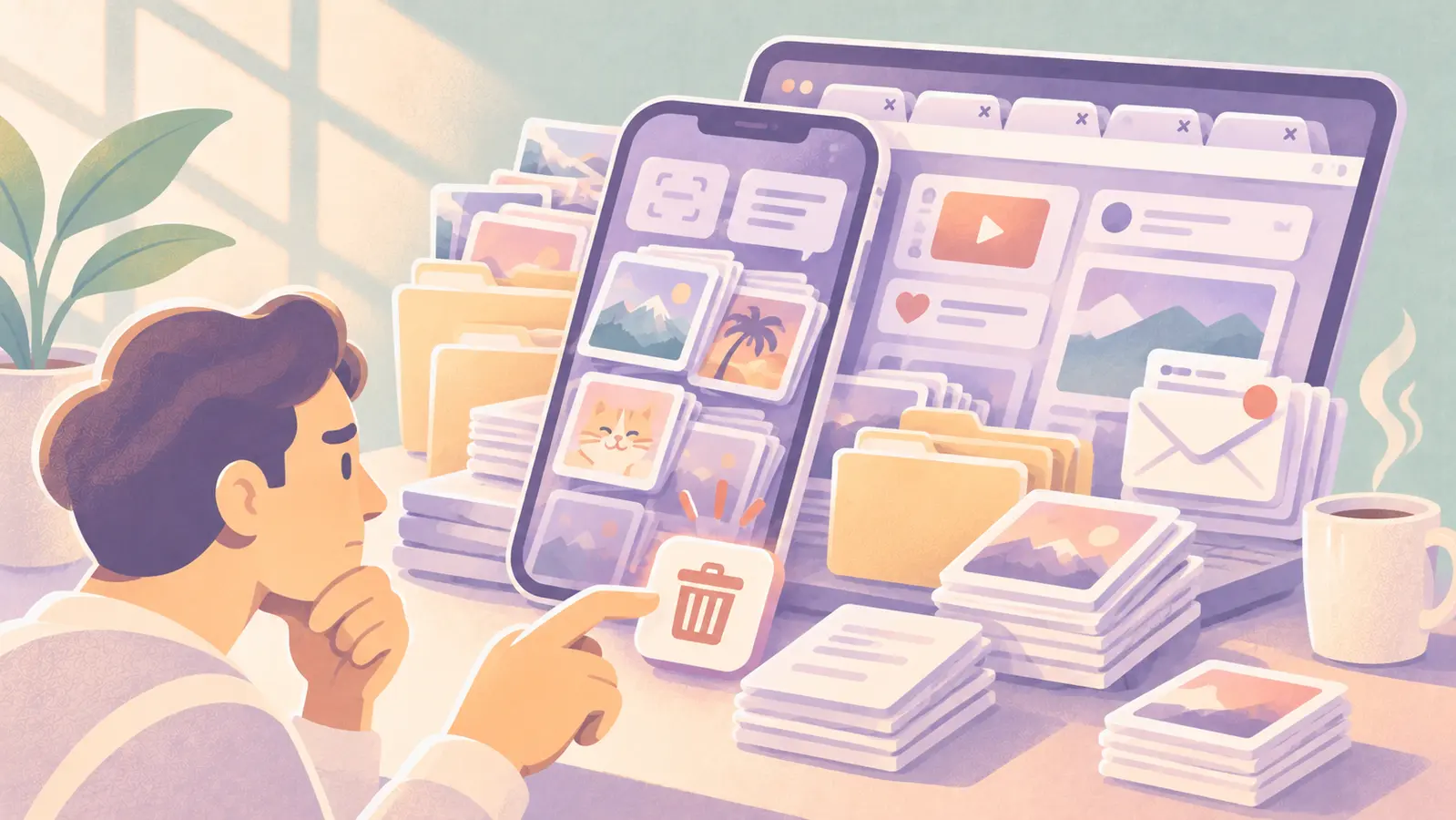
What is digital hoarding? Learn why we keep saving photos, files, emails and links, when digital clutter becomes a problem, and how to let go of what you no longer need.
Think about how much information you've accumulated on your phone and computer over the years. Thousands of photographs, screenshots you barely remember taking, documents from old projects, and articles you saved because you thought they might be useful someday.
Maybe your browser has dozens of bookmarks you've never opened, or your social media accounts contain hundreds of saved posts you keep meaning to revisit. You probably don't need most of them, but deleting them feels strangely unnecessary. After all, they aren't taking up any physical space, and what if you need something later?
So you keep everything.
This is part of a phenomenon researchers call digital hoarding, the tendency to accumulate digital information and struggle to discard it, even when much of that information is no longer useful.
Unlike physical clutter, digital clutter is easy to ignore. You don't have to walk around a pile of old photographs or find room for another box of documents. Everything sits quietly in folders, cloud storage, and apps, often accumulating for years.
But there's an interesting problem with keeping everything: the more information we save, the harder it can become to find and use the things that actually matter.
What Is Digital Hoarding?
Digital hoarding refers to the excessive accumulation of digital files or information, often accompanied by difficulty deleting things and a growing sense of disorganization.
It can involve photographs, emails, screenshots, documents, downloads, bookmarks, saved social media posts, and almost any other type of digital content. But having a large collection of files doesn't automatically mean someone is engaging in problematic digital hoarding.
A photographer might legitimately need thousands of images, while a business may have legal reasons to preserve years of records. The more meaningful distinction is whether someone continues accumulating information they rarely use, finds it difficult to discard unnecessary material, or experiences stress because their collection has become unmanageable.
It's also important to distinguish digital hoarding from a recognized mental health condition. Digital hoarding is an emerging area of research, not a standalone diagnosis in the DSM-5-TR. Researchers have identified similarities with physical hoarding, but digital possessions are fundamentally different because they're easy to duplicate, inexpensive to store, and often invisible until we actively look for them.
A 2026 scoping review published in Humanities and Social Sciences Communications examined the developing research on digital hoarding and identified recurring motivations involving emotional attachment, practical usefulness, control, and personal identity.
The researchers emphasized that digital hoarding isn't simply physical hoarding transferred to a computer. The nature of digital information creates its own reasons for accumulation, along with different challenges when people try to organize or discard it.
And understanding those reasons is useful, because the problem often starts long before our storage becomes full.
Why Do We Save Things We'll Probably Never Use?
One of the biggest reasons we accumulate digital clutter is that almost everything has some imaginable future value.
You might save an article because it contains an interesting idea, keep an old spreadsheet because it could be useful for another project, or take a screenshot of something you might want to remember.
The logic seems reasonable. Keeping the information costs almost nothing, while deleting it creates the possibility that you'll need it someday.
But there's an important difference between something that could be useful and something you're realistically likely to use.
Consider a folder containing hundreds of articles you've saved over the years. You may genuinely have been interested in each one when you found it, but how many have you actually returned to read? And if you needed information about one of those subjects today, would you search through your saved collection or simply look it up again?
This reveals an interesting distinction: saving information can create the feeling of having accomplished something without actually using or learning anything from it.
You haven't necessarily benefited from an article because you bookmarked it, just as downloading an educational video doesn't mean you've learned what it teaches. Sometimes collecting useful information becomes a substitute for doing something useful with it.
Emotional attachment is another significant factor, particularly with photographs and personal messages. A picture might remind you of a relationship, a holiday, or a particular period of your life. Deleting it can feel like losing a small part of that memory, even when you have dozens of nearly identical photographs from the same occasion.
And then there's the difficulty of making decisions. Every file asks a slightly different question. Is this important? Could I need it? Is it sentimental? Do I have another copy? Should I organize it somewhere?
When those decisions accumulate into thousands of items, it can become easier to postpone the entire cleanup than to work through them individually.
Research supports the idea that digital hoarding involves more than simple disorganization. A 2024 study published in Digital Health examined university students and explored how factors including fear of missing out, emotional attachment, information overload, and decision fatigue relate to digital hoarding behavior.
The findings suggest that the reasons people save things can involve emotional and psychological considerations, rather than merely a lack of organizational skills.
And perhaps the most important factor is how effortlessly our devices allow us to accumulate things. Saving another screenshot or bookmarking another article takes seconds, while deciding whether it's worth keeping requires thought.
It's much easier to collect information than to manage it.
When Does Digital Clutter Become a Problem?
One of the interesting things about digital hoarding is that having more information doesn't necessarily make that information more useful.
Imagine two people with thousands of digital files. One has a well-organized collection of meaningful photographs, documents, and resources they regularly use. The other has an equally large collection but struggles to find important files, repeatedly downloads duplicates, and feels overwhelmed whenever they try to organize anything.
The amount of information is similar, but the practical consequences are very different.
That's why I'd pay less attention to the total number of files and more attention to how manageable your digital environment feels.
If you regularly struggle to find important documents among old downloads, save articles you never revisit, or spend time searching through screenshots that no longer serve a purpose, your collection may be creating more work than it's saving.
There's also a potential connection to mental fatigue. A 2025 study published in Frontiers in Psychology surveyed 801 university students and found that greater digital hoarding was associated with more frequent everyday cognitive difficulties, including lapses in attention and memory. Fatigue helped explain part of that statistical relationship.
However, the study relied on self-reported survey data, so it doesn't establish that digital hoarding causes cognitive problems. It does suggest that accumulating and managing digital information may be connected to a broader experience of mental strain.
An older 2019 study published in Computers in Human Behavior also developed a way to measure digital hoarding behaviors, including accumulation and difficulty discarding. It helped establish that the problem isn't simply the size of a digital collection, but also how people relate to the material they're keeping.
There's another practical concern worth considering: retaining information indefinitely can create unnecessary privacy and security risks. Old documents may contain personal details, financial information, or other sensitive material that no longer needs to be stored in multiple places.
Of course, keeping important records is sensible, and nobody should delete essential financial, legal, professional, or personal documents simply to achieve a cleaner-looking folder.
The point is to distinguish genuinely valuable information from material that's accumulating without a clear purpose.
How to Stop Digital Hoarding Without Deleting Everything
If you're interested in reducing digital clutter, I wouldn't start by trying to organize your entire digital life at once.
That can quickly become another overwhelming project, especially if you've accumulated years of files across several devices and services. Instead, choose one category that feels manageable, such as screenshots, downloads, bookmarks, or saved social media posts.
Screenshots are often a particularly useful place to begin because many capture temporary information. You might have saved a product listing, an address, a conversation, or something you wanted to remember briefly. Months later, that information may no longer serve any purpose.
Begin by removing obvious duplicates, outdated screenshots, and files you clearly don't need. Leave sentimental photographs, important records, and difficult decisions for later. You can make meaningful progress without evaluating everything you've ever saved.
I'd also recommend separating information that matters emotionally from information that was saved for practical reasons.
Family photographs, meaningful messages, and personal memories deserve different consideration from old advertisements, random screenshots, or articles you haven't opened in three years. Keeping a dedicated collection of important memories can make it easier to preserve what matters without treating every digital item as equally valuable.
Another useful habit is being more selective before saving something in the first place.
When you encounter an interesting article, ask yourself whether you actually intend to read it. If you have time, perhaps read it now. If you want to remember one useful idea, consider writing down that idea rather than saving the entire page. And if something is merely interesting but unlikely to be useful again, you can enjoy discovering it without needing to preserve it.
The same principle applies to saved social media posts. You might have hundreds of recipes, travel recommendations, productivity tips, and videos tucked away in different apps. But if you rarely return to those collections, their practical value may be smaller than you imagine.
An article you read and apply is usually more valuable than fifty articles you've saved for later.
I'd also keep your organizational system relatively simple. A handful of clearly named folders is often more useful than an elaborate hierarchy that requires constant maintenance. The goal isn't to create a perfect digital archive; it's to make important information easy to find.
Before permanently deleting anything significant, check whether it's backed up and whether you have a genuine reason to retain it. For meaningful memories and important records, maintaining a secure backup is often more valuable than aggressively reducing storage.
Finally, recognize that a one-time cleanup won't accomplish much if you continue saving everything afterward. The most effective long-term change is probably collecting less rather than repeatedly organizing more.
Where LightScroll Fits In
Digital hoarding is primarily about what we accumulate and why we hold on to it, so an app blocker isn't a replacement for proper file management.
But there's a related habit worth considering: how often we save things simply because we're consuming an endless stream of new information.
Social media makes it remarkably easy to discover, bookmark, and collect content faster than we could ever realistically use it. Sometimes reducing that constant consumption can also reduce the temptation to save everything we encounter.
That's part of why we created LightScroll. It helps you establish boundaries around selected apps and websites through scheduled Controls, daily time allowances, and Frictions that encourage you to pause before opening something.
You might use it to spend less time scrolling through feeds, protect time for organizing your digital life, or simply make room for activities that don't involve collecting more information.
You can learn more about how LightScroll works, or explore our guides to digital decluttering and digital minimalism.
Keeping Everything Isn't the Same as Preserving What Matters
There's something understandable about wanting to keep things. Digital files can represent memories, useful information, opportunities, and work we've spent time creating. And because storage is so convenient, keeping something often feels easier than deciding whether we need it.
But a collection becomes less useful when it's so large or disorganized that we can't easily find what matters.
The research on digital hoarding is still developing, and having thousands of photographs or an overflowing downloads folder doesn't automatically mean you have a problem. The more useful question is whether your digital possessions are helping you or creating additional work, stress, and unnecessary decisions.
You don't need to delete meaningful memories, abandon useful resources, or create a perfectly organized digital life.
You can simply become more selective about what deserves a place in it.
The purpose of saving something is to preserve its value, not merely to avoid the possibility of losing it.
Sometimes keeping less makes it easier to appreciate and use what you decide is worth keeping.
Sources and Further Reading
- Bravo-Adasme, N., Cataldo, A., & Grandón, E. (2026). Understanding Digital Hoarding: Conceptual Framework and Future Research Based on a Scoping Review. Humanities and Social Sciences Communications.
- Neave, N. et al. (2019). Digital Hoarding Behaviours: Measurement and Evaluation. Computers in Human Behavior.
- Liu, Y., & Liu, Y. (2025). Hoarding Knowledge or Hoarding Stress? Investigating the Link Between Digital Hoarding and Cognitive Failures Among Chinese College Students. Frontiers in Psychology.
- Zaremohzzabieh, Z. et al. (2024). Exploration of Vulnerability Factors of Digital Hoarding Behavior Among University Students and the Moderating Role of Maladaptive Perfectionism. Digital Health.