
Cyberloafing: Why We Waste Time on the Internet at Work
Derek C.
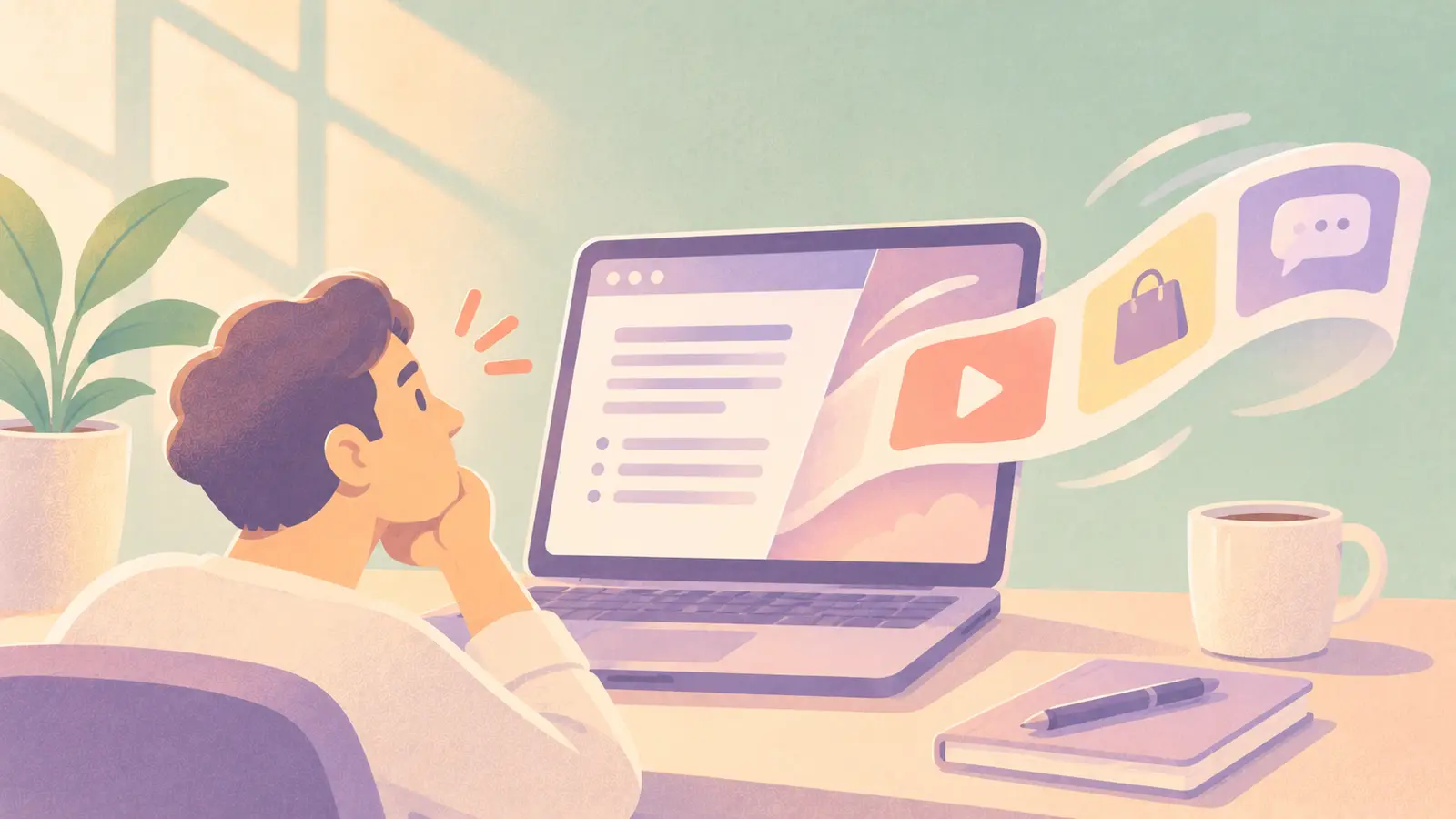
What is cyberloafing? Learn why employees browse social media and personal websites during work, how it affects focus, and when digital breaks can help.
You sit down to work on something important. You open your laptop, check your email, and make a little progress. Then you remember something you wanted to look up, open another tab, and somehow end up reading the news or scrolling through Reddit.
Ten minutes later, you return to your work and try to remember where you left off.
This familiar behavior has a name: cyberloafing. It refers to using the internet for personal activities during working hours, whether that's checking social media, shopping online, watching videos, or browsing websites unrelated to your job.
It's particularly common in modern workplaces because the same devices we use to get things done also provide immediate access to almost unlimited entertainment. The boundary between working and browsing is often just one click away.
But there's an interesting question worth asking: is all personal internet use during work necessarily a problem?
Research suggests the answer is more complicated than it first appears. While excessive cyberloafing can interfere with concentration and productivity, occasional personal browsing can also serve as a short break. Understanding the difference is useful for anyone who wants to spend less time distracted without treating every moment away from work as wasted time.
What Is Cyberloafing?
Cyberloafing, sometimes called cyberslacking, describes using internet-connected devices for personal activities unrelated to your job during working hours.
It might involve checking Instagram between meetings, browsing online stores, reading sports news, watching YouTube, or replying to personal messages. Some researchers focus specifically on employer-provided technology, while others also include personal smartphones used during the workday.
The important distinction is that the activity isn't directly related to the work you're supposed to be doing.
Of course, not every personal interaction with technology is a meaningful productivity problem. Responding to an important family message, checking an appointment, or taking a short break is different from repeatedly spending half an hour browsing unrelated websites when you intended to be working.
That's why context matters. The same activity can be harmless during a planned break but disruptive when it repeatedly interrupts a task that requires concentration.
Cyberloafing also overlaps with procrastination, although the two aren't identical. Procrastination involves delaying something you intend to do, while cyberloafing specifically involves personal internet use during work. Someone avoiding a difficult report by reorganizing their desk is procrastinating, but not cyberloafing. Someone repeatedly opening social media to avoid writing that report may be doing both.
The distinction is useful because the underlying problem isn't always the internet itself. Sometimes browsing is simply the most convenient way to avoid something more difficult.
Why Do We Get Distracted by the Internet at Work?
One of the biggest reasons cyberloafing happens is that digital entertainment is so readily available.
Imagine you're working on a difficult problem. You're making progress, but you reach a point where you're unsure what to do next. Opening Reddit or checking your messages offers an immediate change of pace, often with something more interesting than the task you're struggling with.
That doesn't necessarily mean you're lazy or uninterested in your work. It means the internet offers an extremely convenient alternative whenever your attention starts to wander.
Boredom is another important factor. Repetitive tasks, long periods without meaningful work, or a lack of clear priorities can make personal browsing more appealing. In some situations, cyberloafing may reflect problems with how work is organized rather than simply an individual's inability to concentrate.
A 2017 meta-analysis published in Career Development International examined 54 independent samples and 609 effect sizes related to cyberloafing. The researchers found that boredom, work engagement, and self-control were among the factors strongly associated with the behavior. Employees' attitudes toward personal internet use and opportunities to engage in it were also important.
That's a useful finding because it challenges the idea that cyberloafing can be explained entirely by a lack of discipline.
Someone who feels engaged with a meaningful project may have less reason to seek distraction than someone whose responsibilities are unclear or whose work feels repetitive. Likewise, a person dealing with stress or mental fatigue might browse the internet in an attempt to escape from demanding tasks.
Habit plays a role, too. If you've become accustomed to checking your phone whenever you finish something or encounter a difficult moment, that behavior can continue even when you don't particularly want to browse.
Over time, you might find yourself opening the same websites automatically, not because you're genuinely interested in what they contain, but because checking them has become part of your routine.
Is Cyberloafing Actually Bad for Productivity?
At first glance, the relationship seems straightforward. If you're browsing personal websites instead of working, you're spending less time on the task you intended to complete.
But productivity isn't simply a measure of how many consecutive minutes someone spends looking at work-related material.
The bigger concern is what happens when personal browsing repeatedly interrupts concentration. You might be writing a report, solving a problem, or thinking through an important decision when you switch to another website. Even if you spend only a few minutes browsing, you still have to return to the task and reconstruct what you were doing.
Those interruptions can become particularly costly when the work requires sustained thought.
There's also the problem of losing track of time. A quick visit to a news website might lead to another article, which leads to a video, which leads to something else. None of those individual decisions seems particularly significant, but together they can consume a surprising amount of the workday.
However, the research also suggests that not every personal online activity has a negative effect.
A 2024 integrative review published in Academy of Management Annals examined 135 studies on using technology for non-work purposes during working hours. Researchers Matthew Perrigino, Roshni Raveendhran, and Ji Woon Ryu found that the literature had approached this behavior from several different perspectives, including counterproductive work behavior and recovery.
One of their central observations was that similar activities can have both positive and negative outcomes, depending on how and why they're used.
For example, spending five minutes exchanging messages with a friend might provide a welcome mental break before returning to a difficult task. Spending forty minutes scrolling through social media to avoid that task is a different experience.
The important distinction isn't simply whether the activity involves personal internet use. It's whether it supports recovery or repeatedly interferes with work.
And that suggests a more useful approach than trying to eliminate every personal website from the workday.
The Difference Between Taking a Break and Avoiding Work
One problem with the concept of cyberloafing is that it can make all non-work activity sound like a failure of productivity.
But people aren't designed to maintain perfect concentration for eight consecutive hours. Attention fluctuates, difficult tasks require mental effort, and occasional breaks are a normal part of a sustainable workday.
The difference between an intentional break and problematic cyberloafing often comes down to whether you're making a deliberate choice.
If you finish a demanding task, decide to take ten minutes to relax, and then return to work, that break may serve a useful purpose. You have a reason for stepping away and a reasonable point at which you plan to return.
Compare that with opening Instagram every time you encounter something difficult, then repeatedly losing track of how long you've been scrolling. In that situation, browsing may be less about recovery and more about escaping the discomfort of a task you still need to complete.
It's also worth considering whether the break is genuinely restorative. Sometimes stepping away from work to watch something amusing or message a friend can help. Other times, switching from one demanding screen to another leaves you feeling just as mentally occupied as before.
A short walk, getting some water, or talking with a colleague might provide a better break than another ten minutes of scrolling.
The point isn't that digital breaks are inherently worse. It's that a break should help you return to what matters, rather than quietly becoming another reason to postpone it.
How to Reduce Cyberloafing Without Eliminating Breaks
If personal browsing is taking up more of your workday than you'd like, I'd start by identifying which websites and apps account for most of the distraction.
For many people, it isn't the entire internet. It's a handful of familiar destinations: Instagram, Reddit, YouTube, news websites, or online shopping. Once you recognize those patterns, you can make targeted changes rather than trying to eliminate every enjoyable part of your workday.
One useful approach is to separate focused work from personal browsing. You might decide to avoid distracting websites during your most important work periods, while leaving room for breaks between tasks. The exact schedule matters less than having some structure that helps you distinguish when you're working from when you're choosing to relax.
Turning off nonessential notifications can help, too. If social media recommendations and promotional messages regularly interrupt your concentration, there's little reason to let them appear throughout the day. You can still check those apps when you choose, rather than whenever they ask for your attention.
It's also worth making automatic browsing less convenient. Close tabs you don't need, log out of distracting websites, or move frequently opened apps away from your Home Screen. These small obstacles give you an opportunity to reconsider whether you actually want to browse.
But if you repeatedly use the internet to escape a particular task, I'd look at the task itself.
Perhaps it's too large, poorly defined, or difficult to start. Instead of telling yourself to finish an entire report, identify the next specific action you can take. That might mean outlining the first section, gathering the necessary information, or writing an imperfect opening paragraph.
Sometimes reducing procrastination is less about resisting distractions and more about making the work easier to begin.
And remember that you don't need to maintain perfect concentration throughout the day. A realistic routine that includes focused work and genuine breaks is likely to be more sustainable than one built around never getting distracted.
What Employers Should Understand About Cyberloafing
There's another side to cyberloafing that doesn't receive enough attention: the role of the workplace itself.
If employees are regularly disengaged, constantly distracted, or spending significant parts of the day avoiding their responsibilities, it may be worth examining whether their work is meaningful, appropriately structured, and realistically manageable.
That doesn't mean employees have no responsibility for how they use their time. It means that restricting personal websites won't necessarily address boredom, unclear priorities, poor management, or workloads that have become overwhelming.
Employers can benefit from setting clear expectations around personal internet use while recognizing that breaks are a legitimate part of work.
There's also a difference between evaluating employees based on meaningful outcomes and evaluating them based on how continuously they appear to be working. Someone who completes important responsibilities efficiently shouldn't necessarily be judged less favorably because they occasionally check personal messages.
Excessive monitoring can introduce its own problems, particularly when employees feel they must constantly demonstrate activity rather than concentrate on producing valuable work.
A better approach is to create an environment where responsibilities are clear, breaks are reasonable, and employees have enough autonomy to manage their attention. Employers also have legitimate reasons to establish security policies around work devices and networks, particularly when personal browsing could expose sensitive information or systems to unnecessary risks.
The objective should be a productive workplace, not one where every minute of an employee's day must look productive.
Where LightScroll Fits In
Sometimes the challenge isn't knowing that a website is distracting. It's finding yourself opening it automatically throughout the day, even after deciding you'd rather concentrate.
That's part of why we created LightScroll.
LightScroll helps you create boundaries around selected apps and websites through scheduled Controls, daily time allowances, and Frictions that encourage you to pause before opening something.
For example, you might restrict Instagram, Reddit, or YouTube during your main working hours while leaving them available during breaks or after work. You can also use Focus Sessions to protect periods when you want fewer distractions.
The goal isn't to eliminate personal internet use or make every moment productive. It's to help you follow through on the boundaries you've chosen, rather than allowing automatic browsing to interrupt your work throughout the day.
You can learn more about how LightScroll works, or explore our other articles on staying focused and building healthier digital habits.
Working Better Doesn't Mean Never Taking a Break
Cyberloafing is a useful term for something many of us recognize: the ease with which personal internet browsing can slip into the time we've set aside for work.
Sometimes that behavior is harmless. A short message, an interesting article, or a few minutes of entertainment can provide a welcome break during a demanding day.
But when browsing becomes automatic, prolonged, or a way of repeatedly avoiding difficult tasks, it can interfere with the work we actually want to accomplish.
The research suggests that the most useful response isn't necessarily to eliminate all personal internet use. It's to understand why the behavior happens, recognize when it's becoming disruptive, and create clearer boundaries between focused work and intentional breaks.
You don't need to spend every minute of your workday being productive.
You need to be able to choose when you're working, when you're taking a break, and when it's time to return.
Sources and Further Reading
- Perrigino, M. B., Raveendhran, R., & Ryu, J. W. (2024). Technology Use for Nonwork Purposes at Work: A Behavior-Focused Integrative Review. Academy of Management Annals.
- A Meta-Analytic Investigation of Cyberloafing (2017). Career Development International.
- Cyberloafing: A Review and Research Agenda. Applied Psychology.