
Brain Rot and How Short-Form Content Changes the Way We Think
Juan F.
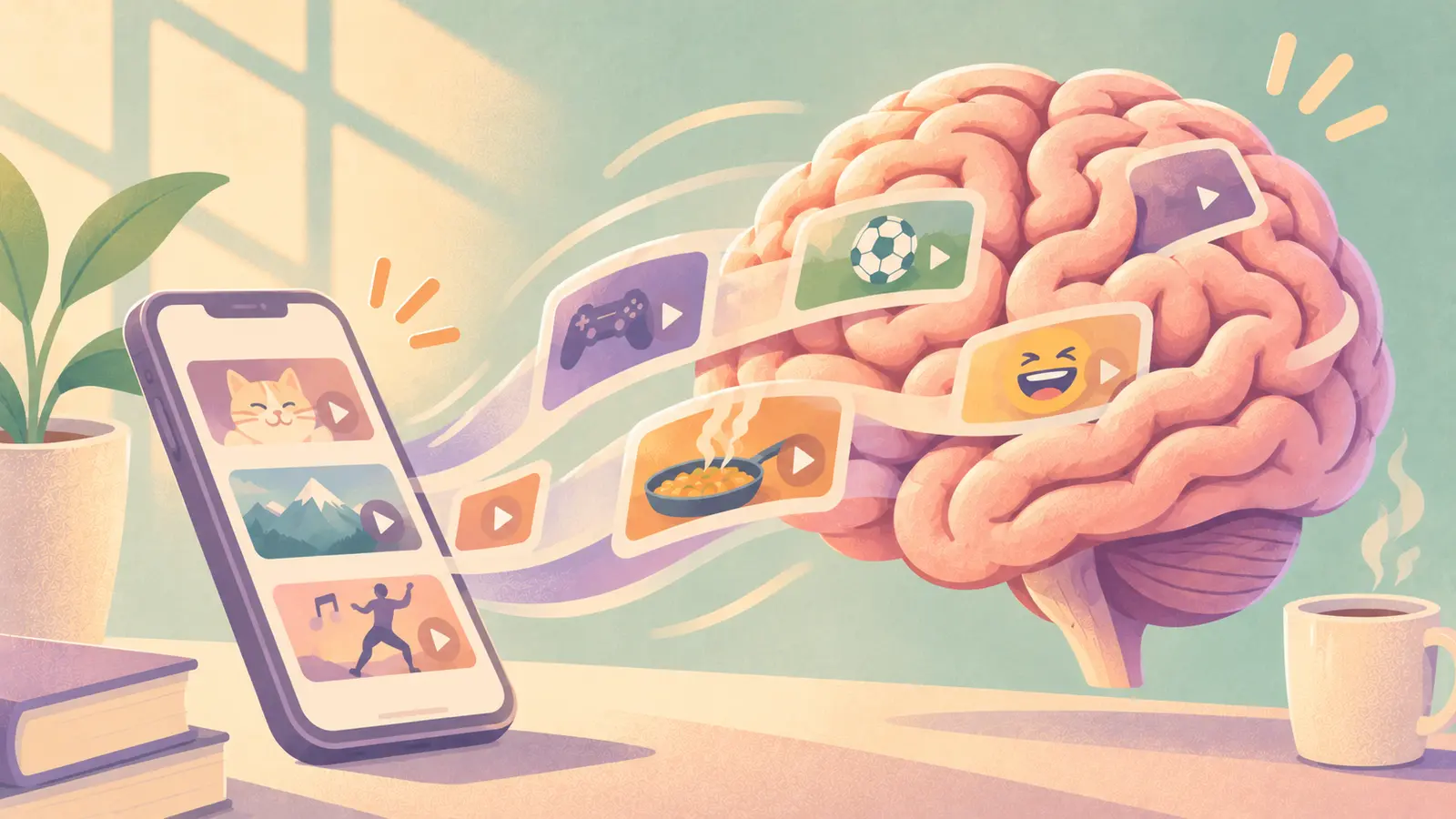
What does brain rot mean? Explore how endless short-form videos may affect attention, self-control and well-being, what research actually says, and how to build healthier viewing habits.
You open TikTok to watch a video someone sent you. Twenty minutes later, you've watched a cooking tutorial, a celebrity interview, a prank, several memes, and a video about a subject you didn't even know existed. You put your phone down, struggling to remember much of what you just watched, and somehow feel like opening it again.
It's a peculiar kind of entertainment. Each video is short, the subject changes constantly, and there's always another one waiting. You don't have to decide what to watch next because the app has already made that decision for you.
Online, people have a name for this experience: brain rot.
The term is usually used jokingly to describe spending too much time consuming repetitive, absurd, or low-effort online content. But behind the humor is a reasonable question. If we're increasingly accustomed to watching videos that last only a few seconds, could that affect how we concentrate, regulate our attention, or engage with activities that require more effort?
Research into short-form video is beginning to provide some answers. The findings are worth taking seriously, although they're more nuanced than the idea that scrolling through TikTok is literally damaging our brains.
What Does Brain Rot Actually Mean?
Brain rot describes the perceived decline in mental sharpness or intellectual engagement associated with consuming large amounts of trivial or unchallenging content, particularly online.
The phrase became so widely used that Oxford University Press selected it as its 2024 Word of the Year, reporting a 230% increase in usage between 2023 and 2024. Interestingly, the expression isn't entirely new. Oxford traces its earliest recorded use to Henry David Thoreau's Walden in 1854, long before anyone could have imagined TikTok or Instagram Reels.
Today, brain rot is commonly associated with endless short-form videos, repetitive memes, and internet humor that doesn't necessarily make much sense outside its own online communities. But it's important to distinguish the cultural expression from an actual medical condition.
Brain rot is not a recognized neurological disorder, and there is no medical diagnosis that results from watching too many short videos.
The concern is better understood as a question about digital habits. When we spend considerable time consuming rapidly changing content, what happens to the time and attention we might otherwise devote to reading, learning, relationships, or more sustained activities?
That doesn't mean every silly video is a problem. Humor and entertainment don't need to be educational to have value. The issue is when watching something becomes less of a choice and more of an automatic response to every spare moment.
Why Is Short-Form Video So Hard to Stop Watching?
One of the most significant differences between short-form feeds and traditional entertainment is the absence of a natural stopping point.
When you watch a film, eventually the credits roll. When you read a book, you reach the end of a chapter. Those moments give you an opportunity to decide whether you want to continue.
TikTok, Instagram Reels, and YouTube Shorts work differently. The next video appears almost immediately, often selected by a recommendation system that has learned from what you've previously watched, liked, or skipped.
This removes much of the effort involved in choosing what to consume. You don't need to search for something interesting, decide whether to commit to a longer video, or even think about what you want to see next. You can simply keep scrolling.
There's also the appeal of variety. A short-form feed might take you from comedy to sports, then to cooking, news, and celebrity gossip in less than two minutes. Each swipe introduces the possibility of something more interesting than the last.
That's part of what makes the experience enjoyable, but it can also make stopping surprisingly difficult. If the current video isn't interesting, perhaps the next one will be. And because the next video requires almost no effort to reach, there's very little reason to stop and reconsider.
Over time, this can become a familiar response to boredom. Waiting for coffee, taking a break from work, sitting on public transportation, or getting ready for bed all become opportunities to watch a few more videos.
The concern isn't that consuming short content is inherently harmful. It's that an endless supply of easy entertainment can gradually crowd out activities that require more deliberate attention.
If you intended to spend twenty minutes reading but repeatedly chose to scroll instead, the immediate consequence isn't necessarily a change in your brain. It's that you spent twenty fewer minutes reading.
When that pattern becomes part of your daily routine, the opportunity cost can become substantial.
Does Short-Form Video Actually Affect Your Attention Span?
This is where the research becomes particularly interesting.
A 2025 systematic review and meta-analysis published in Psychological Bulletin examined 71 studies involving 98,299 participants to understand the relationship between short-form video use, cognitive performance, and mental health.
The researchers found that greater short-form video use was associated with poorer cognitive outcomes overall. Some of the strongest relationships involved attention and inhibitory control, which is the ability to resist impulses or distractions when they interfere with a goal.
The reported correlations were −0.38 for attention and −0.41 for inhibitory control. These are meaningful statistical associations, suggesting that people who engage more heavily with short-form video also tend to perform worse on certain measures of attention and self-regulation.
The researchers also found associations with poorer mental health outcomes, although those relationships were generally weaker.
But there's a crucial distinction: correlation does not establish causation.
The findings don't prove that watching short videos causes attention problems. It's possible that people who already struggle with concentration or impulse control are more likely to spend time on highly stimulating, rapidly changing content. Other factors, including sleep, stress, and existing mental health difficulties, may influence both behaviors.
A separate 2026 systematic review published in BMJ Public Health examined 17 studies focused on adults aged 18–29. It identified preliminary associations between heavier short-form video use and fragmented attention, reduced executive control, and difficulties with emotional regulation.
However, the researchers emphasized that much of the evidence was based on observational studies and self-reported behavior, making it difficult to determine which factors caused which outcomes.
Taken together, these reviews support a reasonable concern about heavy or problematic short-form video consumption, particularly when people find it difficult to regulate their use. They do not establish that watching TikTok permanently reduces someone's attention span, lowers their intelligence, or causes irreversible neurological damage.
That distinction matters because sensational claims about brain rot can distract from the more practical problem: many people are spending more time consuming short-form content than they actually want to.
The Problem Isn't That Videos Are Short
It's worth separating the format of short-form video from the way we consume it.
A thirty-second tutorial might teach you something useful. A short comedy sketch can make you laugh, while a quick science explanation might introduce you to a subject you'd like to explore further. There's no reason to assume that longer content is automatically better or that everything we watch needs to be intellectually demanding.
In fact, a 2025 study published in New Media & Society explored how teenagers engage with brain-rot content as a form of playful, deliberately unserious online participation. The research offers a useful reminder that absurd memes and internet humor can have social and cultural value without needing to serve an educational purpose.
A more meaningful distinction is between choosing to watch something and continuing to watch because the next thing is already there.
Imagine spending an hour watching a documentary you genuinely wanted to see. Now compare that with spending an hour scrolling through hundreds of unrelated videos, many of which you don't particularly remember or enjoy.
Both experiences involve the same amount of screen time, but they may serve very different purposes.
That's why I wouldn't judge short-form content exclusively by its length or subject matter. I'd pay more attention to how often you're opening the app without a reason, whether you're spending longer than intended, and what other activities you might be postponing to continue watching.
If your habits are interfering with sleep, concentration, work, or things you genuinely enjoy, that's a more useful reason to make a change than worrying that every short video is harming your brain.
How to Reduce Brain Rot Without Giving Up Entertainment
If short-form video has become a larger part of your day than you'd like, I'd start by looking at when you tend to watch it.
For many people, scrolling isn't necessarily a planned activity. It's something that happens between other activities. You finish a task, reach for your phone, and open TikTok without consciously deciding to. Or you sit down for a short break and discover that half an hour has passed.
Recognizing those patterns is useful because it gives you something specific to change.
One approach is to give yourself designated times for short-form entertainment rather than opening feeds whenever you're bored. Perhaps you enjoy watching videos for twenty minutes after dinner, but you'd prefer to keep them out of your workday or morning routine. Setting those boundaries can help distinguish entertainment you've chosen from entertainment you've fallen into.
I'd also recommend making your most distracting apps a little less convenient to open. Move them away from your Home Screen, disable notifications that encourage you to return, or set a daily time allowance. These changes won't eliminate the appeal of scrolling, but they can interrupt the automatic habit of opening an app without thinking.
It's also worth making room for activities that require more sustained attention. Read a chapter of a book, watch a longer video about something you genuinely want to learn, practice a skill, or work on a creative project. You don't need to treat these activities as exercises designed to repair your attention span. They're simply opportunities to spend time engaging with something more deliberately.
And don't underestimate the value of having a few quiet moments without any content at all. Waiting in line or taking a short walk doesn't always need to involve watching something. Sometimes allowing yourself to be bored is preferable to automatically filling every available minute with another feed.
The goal isn't to become someone who never watches short videos. It's to make sure they remain one form of entertainment among many, rather than the default activity that fills every opening in your day.
Where LightScroll Fits In
One difficulty with changing a scrolling habit is that knowing what you want to do doesn't necessarily make it easy to follow through. You might decide to spend less time watching Reels during work, only to find yourself opening Instagram automatically the next morning.
That's part of why we created LightScroll.
LightScroll helps you set boundaries around selected apps and websites on supported Apple devices through scheduled Controls, daily time allowances, and Frictions that encourage you to pause before opening something.
For example, you could give yourself a reasonable daily allowance for TikTok or Instagram while restricting those apps during work or before bed. Rather than relying entirely on willpower, you can make your preferred routine easier to maintain.
The idea isn't to eliminate entertainment or make every spare moment productive. It's to give yourself more control over how much of your day is spent scrolling.
You can learn more about how LightScroll works.
Your Brain Probably Isn't Rotting, but Your Time Still Matters
The phrase brain rot captures a feeling that many people recognize: spending a long time consuming fast-moving, repetitive content and wondering afterward whether it was worth it.
Scientific research gives us reasons to take heavy or problematic short-form video use seriously, particularly because of its associations with attention and self-regulation. But it doesn't support the exaggerated idea that watching short videos literally causes your brain to deteriorate.
And there's nothing wrong with watching something silly. Entertainment, humor, and relaxation are worthwhile parts of life.
The more important question is whether your media habits reflect how you actually want to spend your time.
If you're choosing to watch something because you enjoy it, that's one thing. If you're repeatedly losing an hour to scrolling when you intended to do something else, that's worth paying attention to.
You don't have to stop watching short videos. You just need to make sure that watching them isn't stopping you from doing everything else.
Sources and Further Reading
- Oxford University Press (2024). Brain Rot Named Oxford Word of the Year 2024.
- Feeds, Feelings, and Focus: A Systematic Review and Meta-Analysis Examining the Cognitive and Mental Health Correlates of Short-Form Video Use (2025). Psychological Bulletin.
- Arouch, S. et al. (2026). Short-Form Video, Cognitive and Mental Health Outcomes: A Systematic Review. BMJ Public Health.
- Owens, E. (2025). 'It Speaks to Me in Brain Rot': Theorising 'Brain Rot' as a Genre of Participation Among Teenagers. New Media & Society.